
Legs · Smith machine
Smith Machine Deadlift
The Smith machine deadlift is a compound strength exercise that targets the glutes, hamstrings, and lower back along a fixed vertical plane. It works well as a primary hinge movement for hypertrophy or as a controlled alternative to free-weight deadlifts in a lower-body session.
- Equipment
- Smith machine
- Type
- Strength
- Animation
- Men and women
How to do it
- Stand inside the Smith machine with your feet shoulder-width apart.
- Bend your knees slightly and hinge at your hips to grab the bar.
- Keep your back straight and grip the bar with your hands just outside your legs, palms facing your body.
- Inhale and brace your core. Exhale as you straighten your legs and lift the bar by extending your hips, keeping your back straight.
- Lift the bar until you are standing upright, then pause at the top.
- Focus on using your glutes, hamstrings, and lower back to perform the lift.
- Slowly lower the bar back to the starting position by bending at your hips and slightly bending your knees.
Common mistakes
- Placing the feet too far in front or behind the bar, which alters hip mechanics and puts excessive shear stress on the lower back.
- Rounding the spine during the lift, which shifts the load away from the hips directly onto the spinal discs.
- Hyperextending the lower back at the top lockout, which strains lumbar facet joints without providing extra glute activation.
Tips
- Align the midfoot directly beneath the bar before starting the hinge to maintain optimal leverage on the fixed track.
- Brace the core and engage the lats prior to each repetition to keep the spine rigid and protected.
- Drive through the heels and extend the hips forward rather than pulling the load upward with your arms or lower back.
Sets and reps
For muscle hypertrophy and general strength, perform 3 to 4 sets of 8 to 12 repetitions, resting 2 to 3 minutes between work sets.
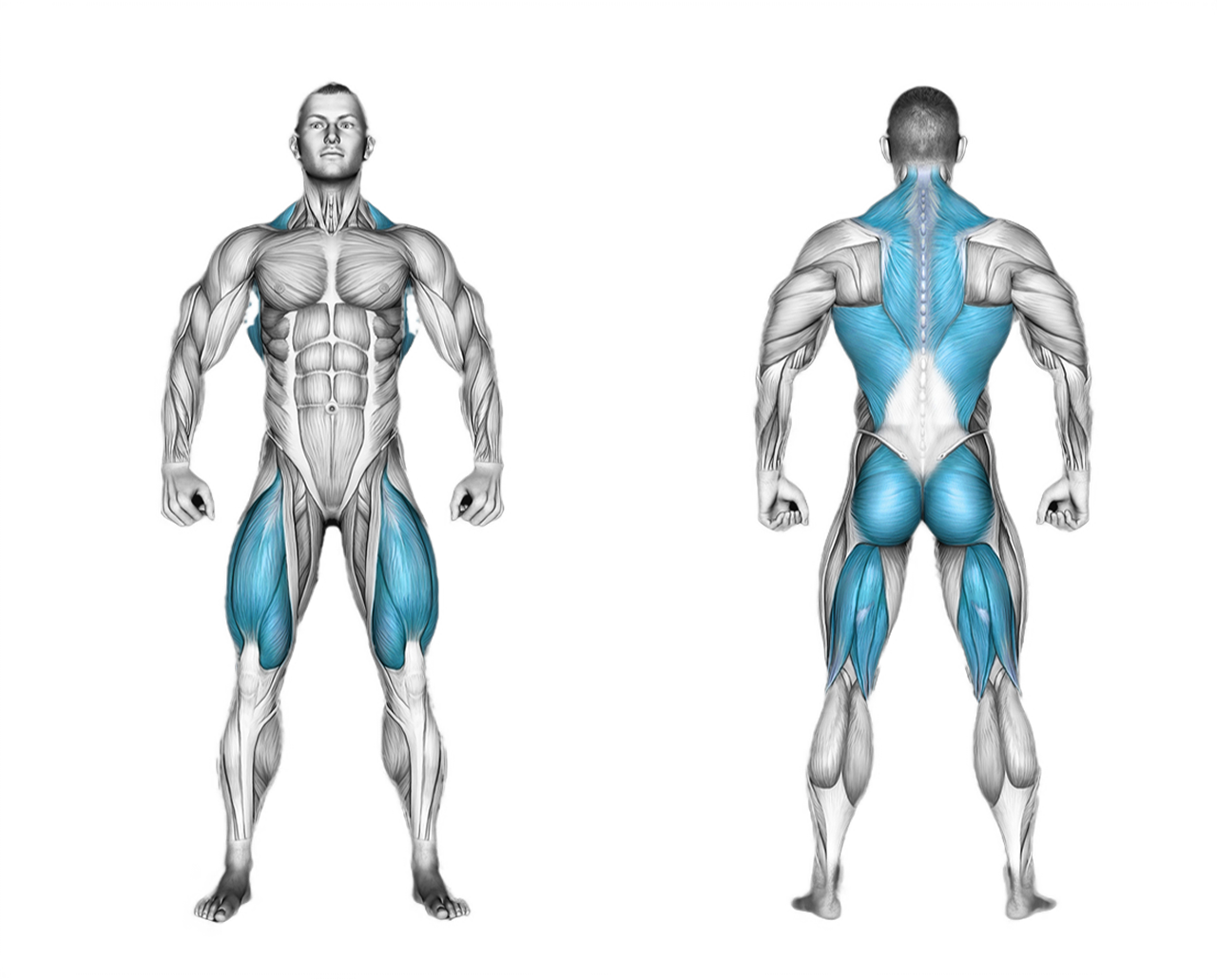
Muscles worked
Your coach guides every set
Turn on the coach in Gloox: it asks how you feel, picks the weight from your history and cues technique and rest. Rate each set and the next one is tuned to you.

On a computer? Point your phone's camera here to get the app.
Questions
Is the Smith machine deadlift safer for the lower back than a barbell deadlift?
It eliminates the need to balance the bar, but the predetermined bar path does not accommodate everyone's natural movement mechanics. If you experience lower back pain, stop the exercise and consult a qualified specialist.
Which muscles are primarily working during this lift?
The movement heavily engages the gluteus maximus, hamstrings, and erector spinae. The quadriceps, core, and upper back act as secondary stabilizers throughout the range of motion.
Similar exercises
Smith Split SquatSmith machine
Smith Machine Full SquatSmith machine
Smith Machine SquatSmith machine
Smith Sumo SquatSmith machine
Smith Sumo DeadliftSmith machine
Resistance Band Side Walk SquatResistance bands
Resistance Band Side LungeResistance bands
Resistance Band Lateral Step and SquatResistance bands