
Legs · Resistance bands
Resistance Band Side Lunge
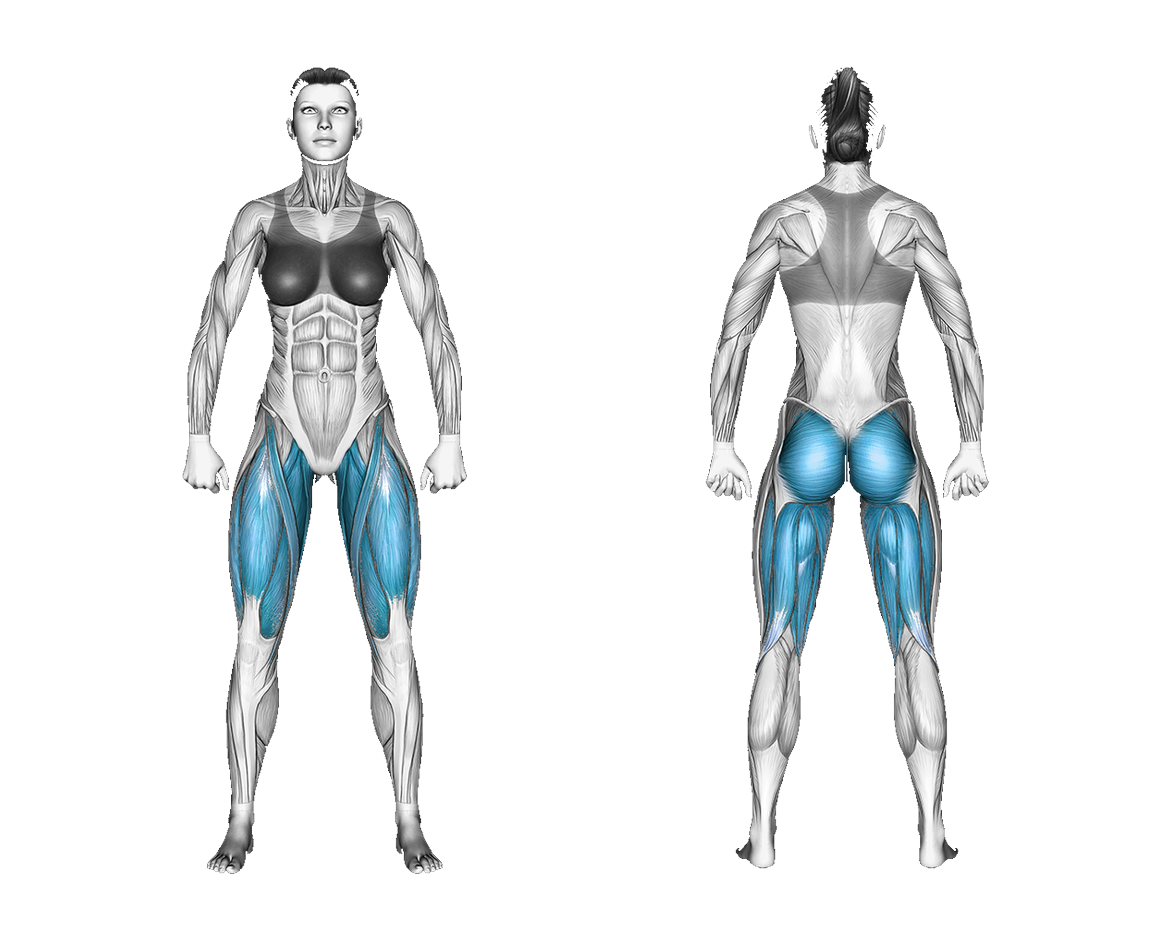
The resistance band side lunge is a functional frontal-plane movement that targets the quadriceps, glutes, and adductors while challenging lateral stability. The added band tension demands greater activation from the gluteus medius, making it ideal for lower-body warm-ups, athletic conditioning, or hypertrophy training.
- Equipment
- Resistance bands
- Type
- Strength
- Animation
- Women
How to do it
- Loop the band around your thighs just above your knees and stand with your feet hip-width apart.
- Keep your chest up and your hands together in front of your chest for balance.
- Inhale and take a wide step to the side, bending the stepping knee and pushing your hips back into a side lunge while the other leg stays straight.
- Keep the band taut and both feet flat on the floor.
- As you exhale, push off the bent leg and return to the starting position.
- Repeat on the other side.
Common mistakes
- Allowing the working knee to cave inward, which reduces glute activation and places unsafe shear stress on the knee joint.
- Lifting the foot of the trailing straight leg off the floor, which compromises pelvic stability and reduces the stretch on the adductors.
- Bending excessively at the waist instead of pushing the hips back and down, shifting the load from the legs to the lower back.
- Allowing the resistance band to go slack between repetitions, which removes continuous tension from the hip abductors.
Tips
- Place the band two to three inches above the knees and maintain slight tension even in the starting stance.
- Sit back into your hip on the stepping leg, keeping the knee tracking directly over your middle toes.
- Keep your chest upright and clasp your hands in front of your chest to help maintain balance and a neutral spine.
Sets and reps
For hypertrophy and endurance, complete 3 to 4 sets of 10 to 15 reps per leg with 60 to 90 seconds of rest between sets. If using this move as a warm-up or glute activation drill, 2 sets of 12 reps per side with light-to-moderate resistance is sufficient.
Muscles worked
Your coach guides every set
Turn on the coach in Gloox: it asks how you feel, picks the weight from your history and cues technique and rest. Rate each set and the next one is tuned to you.

On a computer? Point your phone's camera here to get the app.
Questions
Which muscles benefit most from adding the resistance band?
While the quads and adductors manage the lunge, the band specifically forces the gluteus medius and minimus to work continuously to keep the knees apart.
What should be done if sharp knee pain occurs during the movement?
Stop the exercise immediately and consult a physical therapist or healthcare professional to assess joint mechanics before resuming lateral lunges.
Similar exercises
Resistance Band Side Walk SquatResistance bands
Resistance Band Lateral Step and SquatResistance bands
Resistance Band Bulgarian SquatResistance bands
Band Seated Hip Internal RotationResistance bands
Resistance Band Lying Leg PressResistance bands
Resistance Band SquatResistance bands
Resistance Band Squat Step OutResistance bands
Band SquatResistance bands