
Shoulders · Resistance bands
Resistance Band Lying Shoulder Abduction
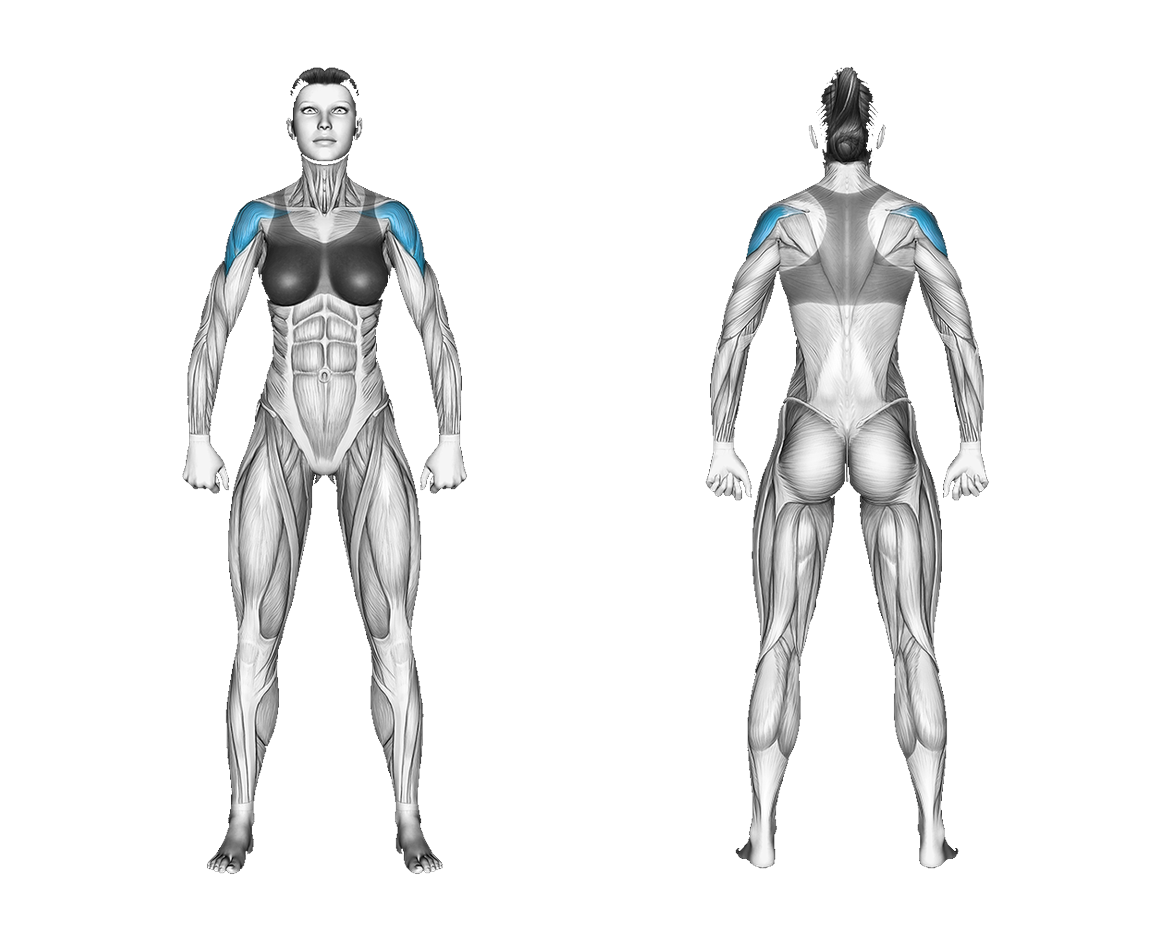
This is an isolation movement targeting the lateral deltoid, performed in a side-lying position against the resistance of an elastic band. It works well at the end of a shoulder workout or in home routines where joint-friendly constant tension is needed.
- Muscles
- Shoulders
- Equipment
- Resistance bands
- Type
- Strength
- Animation
- Women
How to do it
- Lie on your side with your legs slightly bent for stability.
- Pin one end of the band to the floor with your bottom hand in front of your body and grasp the other end with your top hand, arm resting along your side.
- As you exhale, raise your straight top arm up in a wide arc until it points toward the ceiling.
- Keep your torso still and avoid rolling backward.
- Inhale and slowly lower your arm back along your side.
- Complete all repetitions, then switch sides.
Common mistakes
- Rolling the torso backward during the lift, which shifts tension away from the shoulder and onto the upper back.
- Allowing the band to snap the arm down quickly, eliminating the benefits of the eccentric phase.
- Excessively bending the working elbow, which shortens the lever arm and reduces stress on the lateral deltoid.
Tips
- Keep your hips and shoulders stacked vertically throughout the entire range of motion to isolate the deltoid.
- Maintain a soft, locked bend in the elbow rather than shifting elbow angles as you move.
- Adjust resistance by choking up on the band to ensure you can reach a full vertical arc with control.
Sets and reps
Perform 3 to 4 sets of 12 to 20 repetitions per side with 45 to 60 seconds of rest between sets to target shoulder hypertrophy and endurance.
Muscles worked
Your coach guides every set
Turn on the coach in Gloox: it asks how you feel, picks the weight from your history and cues technique and rest. Rate each set and the next one is tuned to you.

On a computer? Point your phone's camera here to get the app.
Questions
What muscles does the lying shoulder abduction work?
The primary mover is the lateral deltoid, while the supraspinatus and other rotator cuff muscles assist in stabilizing the shoulder joint.
What should you do if you feel joint pain during this movement?
Stop the movement immediately and reduce the range of motion or consult a physical therapist if pain persists.
Similar exercises
Resistance Band 90 Degrees External RotationResistance bands
Resistance Band Standing 90 Degrees Shoulder External RotationResistance bands
Resistance Band Standing Shoulder External RotationResistance bands
Resistance Band Standing Around the WorldResistance bands
Band Bent Over Rear Deltoid KickbackResistance bands
Resistance Band Single Arm Lateral RaiseResistance bands
Resistance Band Standing Single Arm Lateral Shoulder RaiseResistance bands
Resistance Band Standing Single Arm Shoulder FlexionResistance bands