
Shoulders · Resistance bands
Band Rear Delt Row
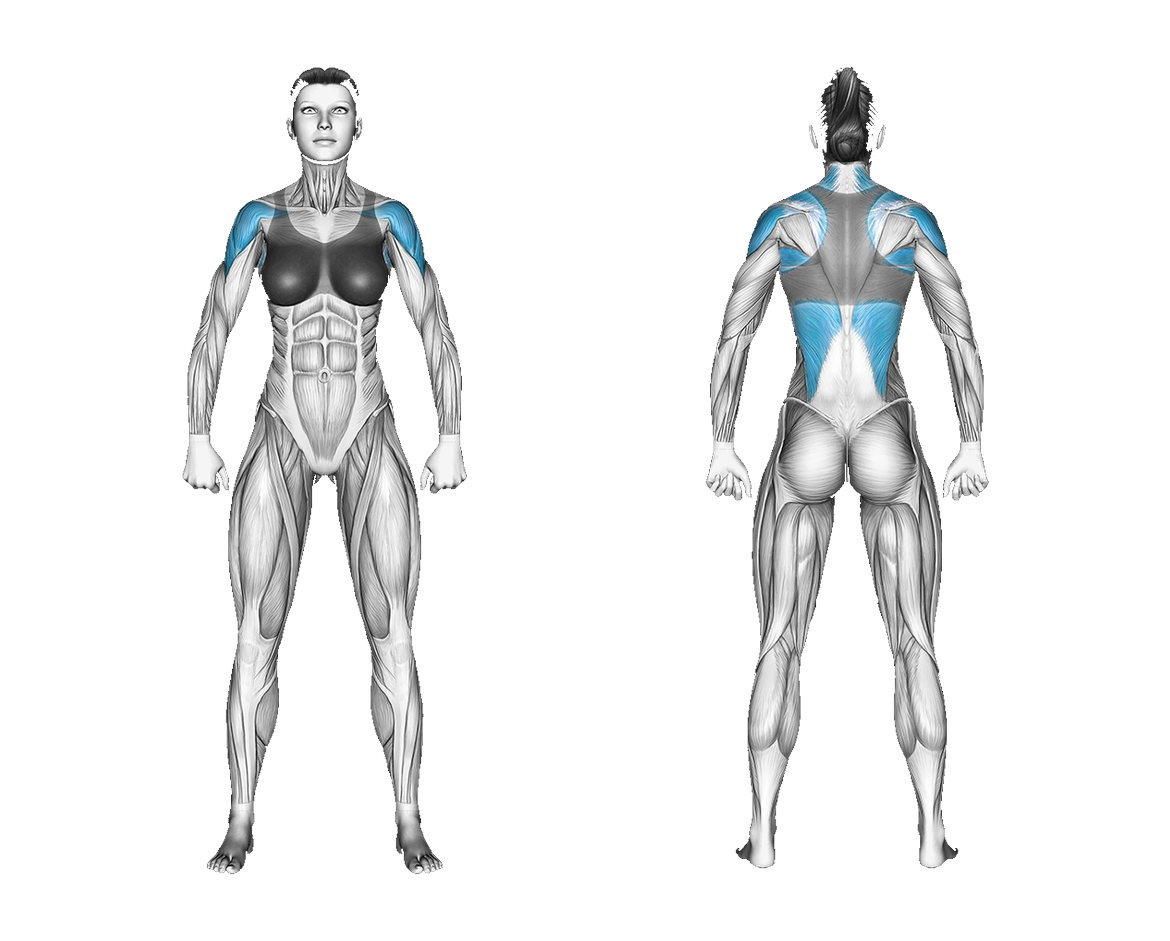
The band rear delt row is an accessory movement targeting the posterior deltoids, rhomboids, and middle trapezius. It helps balance shoulder development and supports posture, making it ideal for the middle or end of an upper-body workout.
- Equipment
- Resistance bands
- Type
- Strength
- Animation
- Women
How to do it
- Anchor the band at chest height in front of you and grab a handle in each hand.
- Step back until the band is taut, arms extended forward at shoulder height, palms facing down.
- Stand with your feet shoulder-width apart, knees slightly bent, core braced. Inhale.
- As you exhale, pull the handles toward your face, flaring your elbows out wide at shoulder height and squeezing your rear delts and shoulder blades.
- Inhale and slowly extend your arms back to the starting position.
Common mistakes
- Dropping the elbows close to the torso shifts the workload to the lats instead of the rear deltoids.
- Shrugging the shoulders toward the ears overactivates the upper traps and strains the neck.
- Leaning the torso backward to initiate the pull uses momentum instead of rear delt contraction.
- Allowing the band to snap the arms forward quickly eliminates the beneficial eccentric phase.
Tips
- Keep your elbows flared wide at shoulder height throughout the entire pull.
- Pause for one second at peak contraction to maximize tension in the posterior delts.
- Set your distance so the band remains slightly taut even when your arms are fully extended forward.
Sets and reps
Perform 3 to 4 sets of 12 to 20 reps with 45 to 60 seconds of rest between sets. Focus on continuous tension and strict control rather than using an excessively heavy resistance band.
Muscles worked
Your coach guides every set
Turn on the coach in Gloox: it asks how you feel, picks the weight from your history and cues technique and rest. Rate each set and the next one is tuned to you.

On a computer? Point your phone's camera here to get the app.
Questions
Can this exercise replace the cable face pull?
Yes, it targets the same posterior shoulder and upper back musculature, serving as an effective and accessible alternative.
What should you do if you feel pain in the shoulder joint?
Stop the exercise immediately and consult a healthcare professional if pain or sharp discomfort persists.
Similar exercises
Resistance Band Bent over Reverse FlyResistance bands
Resistance Band Sitting Bent over Reverse Fly on a ChairResistance bands
Band Reverse FlyResistance bands
Band Upright Row (Under Two feet)Resistance bands
Resistance Band Pull ApartResistance bands
Resistance Band Supinated Grip Pull ApartResistance bands
Band Bent over Rear Lateral RaiseResistance bands
Band Bent over Rear Lateral Raise (Version 2)Resistance bands