
Shoulders · Resistance bands
Band Standing Rear Delt Row
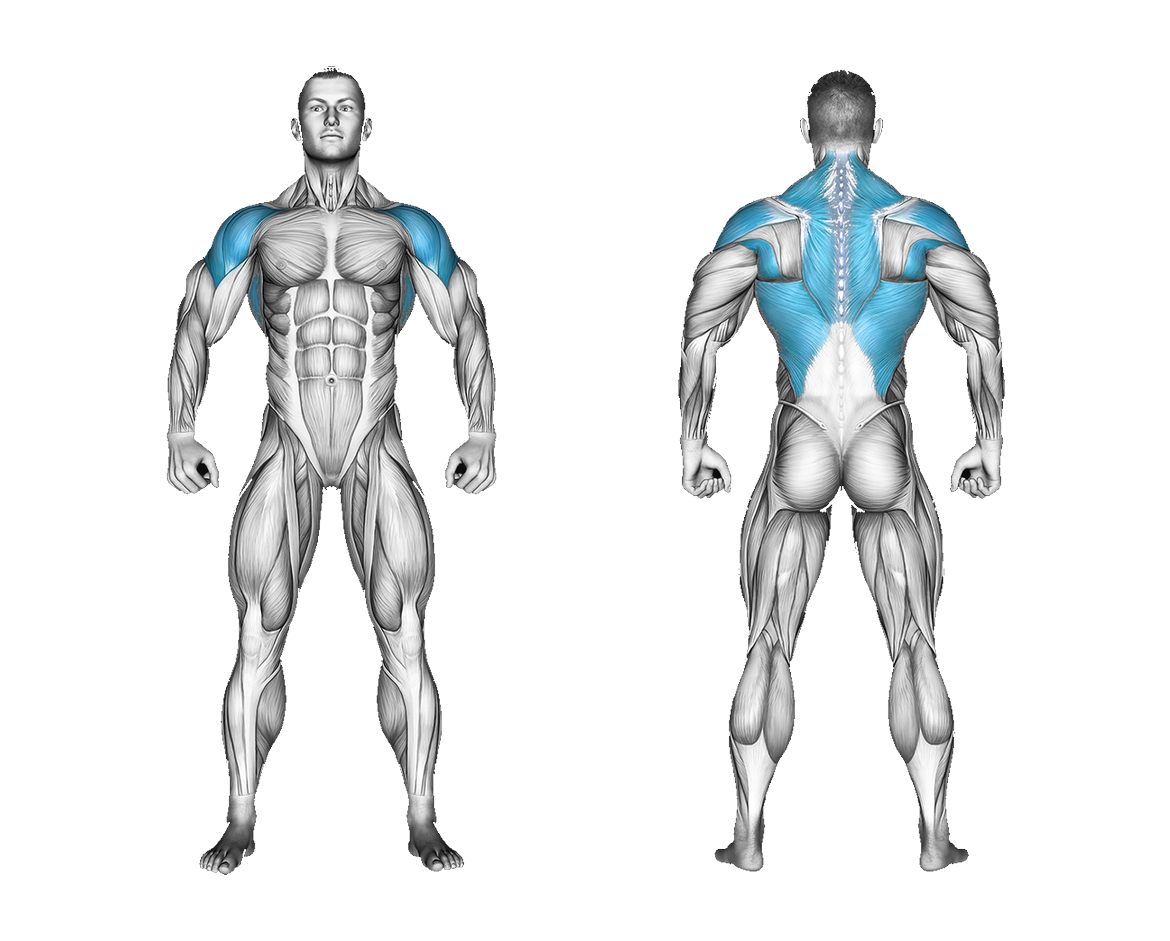
The band standing rear delt row is an isolation exercise designed to target the posterior deltoids, rhomboids, and middle trapezius. It works well for all fitness levels to build shoulder balance, support posture, and serve as an accessory movement at the end of an upper-body workout.
- Equipment
- Resistance bands
- Type
- Strength
- Animation
- Men and women
How to do it
- Anchor the band at chest height in front of you and take a handle in each hand.
- Stand facing the anchor with your feet shoulder-width apart and step back until the band is taut, arms extended at shoulder height.
- Keep your back straight and core braced, then inhale.
- As you exhale, pull the handles toward your face, flaring your elbows out wide at shoulder height and squeezing your shoulder blades together.
- Pause for a moment at the end of the pull.
- Inhale and slowly extend your arms back to the starting position.
Common mistakes
- Dropping your elbows below shoulder height shifts tension away from the rear delts and onto the latissimus dorsi.
- Shrugging the shoulders upward during the pull excessively activates the upper traps and limits rear delt involvement.
- Leaning your torso back to yank the band relies on momentum instead of controlled muscular contraction.
Tips
- Focus on driving your elbows back and wide rather than pulling primarily with your hands.
- Pause for a full second at peak contraction to maximize time under tension.
- Step far enough from the anchor point so the band remains taut even when your arms are fully extended.
Sets and reps
Perform 3 to 4 sets of 12 to 20 controlled repetitions with 45 to 60 seconds of rest between sets to target hypertrophy and muscular endurance.
Muscles worked
Your coach guides every set
Turn on the coach in Gloox: it asks how you feel, picks the weight from your history and cues technique and rest. Rate each set and the next one is tuned to you.

On a computer? Point your phone's camera here to get the app.
Questions
How does this exercise differ from a face pull?
While similar, this row keeps the pull in a strict horizontal plane with flared elbows, avoiding the external shoulder rotation emphasized in a traditional face pull.
Is this movement safe if you have lower-back sensitivity?
Yes, performing the row standing upright removes the compressive spinal load typical of bent-over dumbbell flyes, making it much easier on the lower back.
Similar exercises
Resistance Band Bent over Reverse FlyResistance bands
Resistance Band Sitting Bent over Reverse Fly on a ChairResistance bands
Band Reverse FlyResistance bands
Band Upright Row (Under Two feet)Resistance bands
Resistance Band Pull ApartResistance bands
Resistance Band Supinated Grip Pull ApartResistance bands
Band Bent over Rear Lateral RaiseResistance bands
Band Bent over Rear Lateral Raise (Version 2)Resistance bands