
Back · Resistance bands
Resistance Band Standing Row
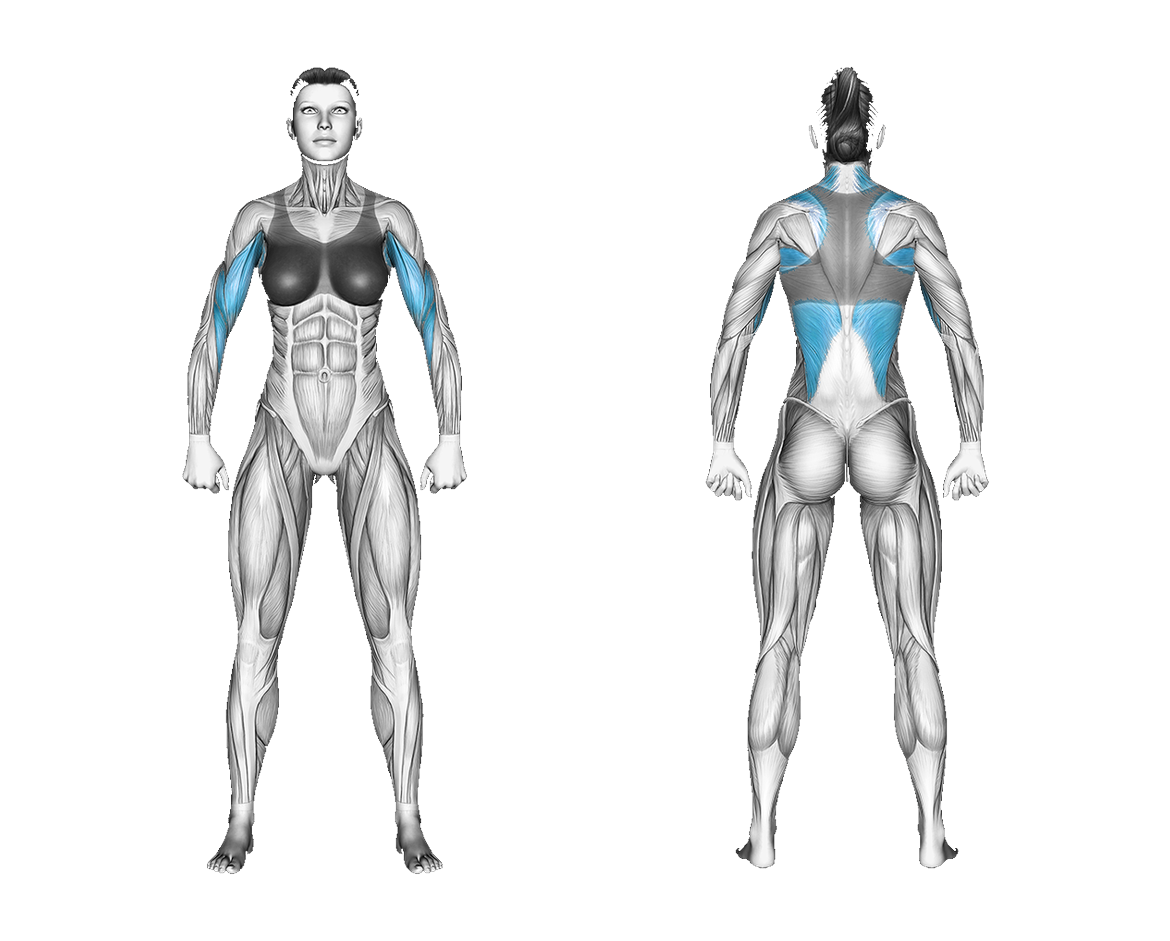
The resistance band standing row is a functional horizontal pulling movement that targets the lats, rhomboids, rear deltoids, and biceps. It suits lifters of all experience levels and works well as a primary pulling exercise in home workouts, a warm-up drill, or a high-rep finisher.
- Equipment
- Resistance bands
- Type
- Strength
- Animation
- Women
How to do it
- Anchor the band securely at waist height to a sturdy post or door and stand facing the anchor.
- Grasp the sides of the loop with both hands and step back until the band is taut, arms extended in front of you.
- Stand with your feet shoulder-width apart, knees slightly bent and back straight.
- As you exhale, pull your hands toward your waist, driving your elbows back close to your body and squeezing your shoulder blades together.
- Inhale and slowly extend your arms back to the starting position.
Common mistakes
- Shrugging your shoulders upward during the pull shifts the load to the upper traps and disengages the lats.
- Leaning your torso back to yank the band uses momentum rather than back strength to complete the rep.
- Flaring your elbows out wide reduces activation of the lats and places unnecessary strain on the shoulder joints.
- Letting the band snap your arms forward on the return phase removes beneficial tension from the eccentric contraction.
Tips
- Initiate each pull by retracting your shoulder blades before driving your elbows backward.
- Pause for a full second when your hands reach your torso to maximize peak contraction in the mid-back.
- Adjust the resistance instantly by taking a half-step toward or away from the anchor point.
Sets and reps
Perform 3 to 4 sets of 12 to 20 controlled repetitions with 45 to 60 seconds of rest between sets to target hypertrophy and muscular endurance. For warm-ups or rehabilitation work, aim for 2 to 3 sets of 15 to 25 light reps.
Muscles worked
Your coach guides every set
Turn on the coach in Gloox: it asks how you feel, picks the weight from your history and cues technique and rest. Rate each set and the next one is tuned to you.

On a computer? Point your phone's camera here to get the app.
Questions
Is the standing band row safe for the lower back?
Yes, because you remain upright rather than bent over, this variation places minimal shear stress on the lumbar spine. If you experience any pain, stop immediately and consult a healthcare professional.
How can I set this up without a dedicated anchor post?
You can secure the band using a door anchor placed at waist height, or transition to a seated row by looping the band securely around your feet.
Similar exercises
Resistance Band Bent over Row (Version 2)Resistance bands
Band Bent over RowResistance bands
Resistance Band One Arm Bent over RowResistance bands
Band Knelling Lat PulldownResistance bands
Band Straight Back Seated RowResistance bands
Resistance Band Seated RowResistance bands
Band Seated RowResistance bands
Band Close Grip RowResistance bands