
Back · Resistance bands
Resistance Band One Arm Bent over Row
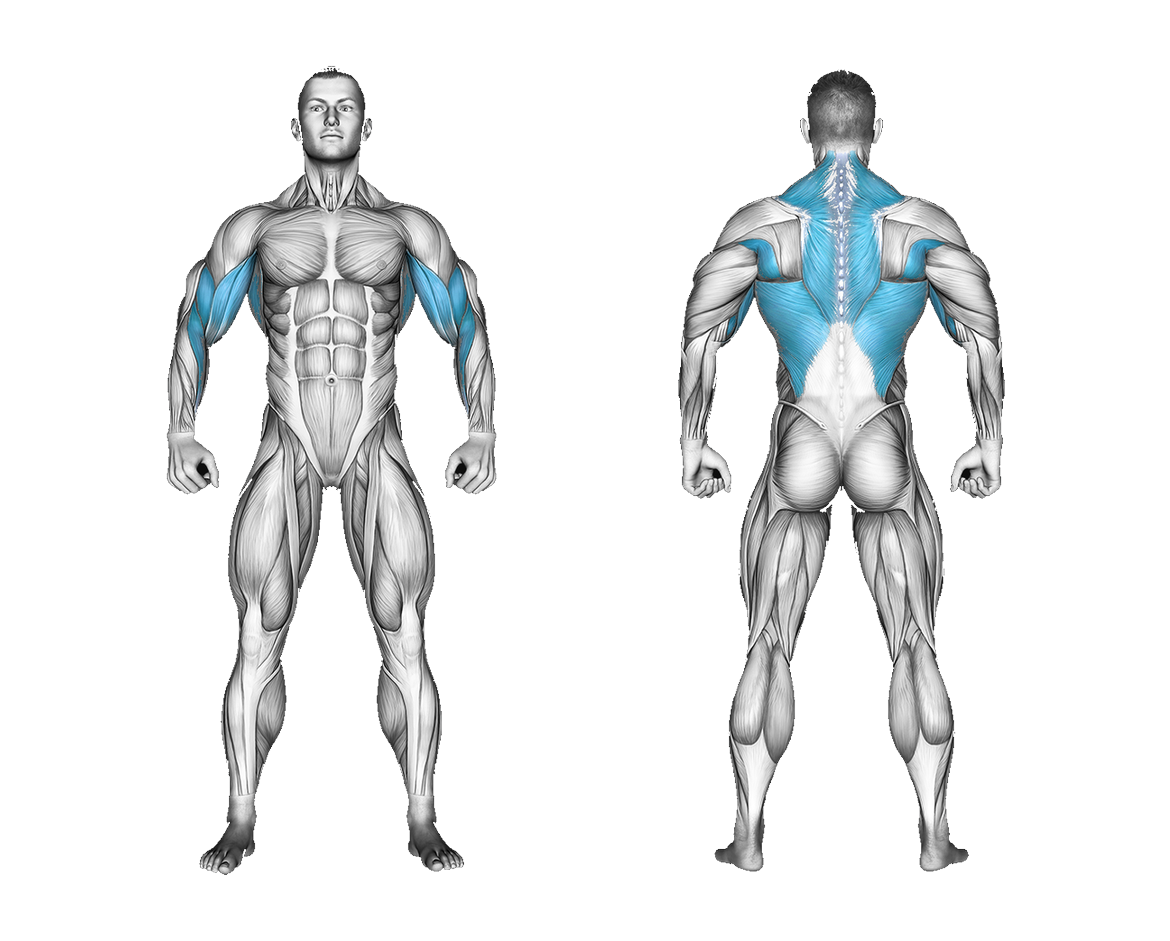
The resistance band one arm bent over row is a unilateral strength exercise that targets the latissimus dorsi, rhomboids, rear deltoids, and biceps. It is an effective option for home or travel routines to correct side-to-side imbalances and belongs in the main pull or upper-body portion of a workout.
- Equipment
- Resistance bands
- Type
- Strength
- Animation
- Men
How to do it
- Stand on one end of the loop band with your feet hip-width apart and grip the other end with one hand.
- Hinge at your hips until your torso is close to parallel to the floor, back straight, free hand resting on your thigh or a bench.
- Let the working arm hang straight down with the band taut.
- Inhale, then as you exhale, pull the band up toward your waist, driving your elbow back along your side and squeezing your shoulder blade.
- Inhale and slowly lower your arm back to the starting position.
- Complete all repetitions, then switch arms.
Common mistakes
- Rounding the lower back shifts mechanical stress onto the lumbar spine and reduces tension on the lats.
- Using torso momentum to jerk the band upward reduces muscle activation and compromises control.
- Pulling with the forearm toward the chest instead of driving the elbow back toward the hip places excessive strain on the biceps.
- Allowing the band to go completely slack at the bottom eliminates tension in the stretched position.
Tips
- Brace your non-working hand firmly on your thigh or a sturdy bench to keep your spine neutral throughout the set.
- Adjust the resistance easily by choking up on the band or altering where your foot anchors it.
- Pause for a deliberate second at the top of the pull, actively squeezing your shoulder blade toward your spine.
Sets and reps
Perform 3 to 4 sets of 10 to 15 controlled repetitions per arm, resting 60 to 90 seconds between sides.
Muscles worked
Your coach guides every set
Turn on the coach in Gloox: it asks how you feel, picks the weight from your history and cues technique and rest. Rate each set and the next one is tuned to you.

On a computer? Point your phone's camera here to get the app.
Questions
Is this exercise safe for individuals with lower back sensitivity?
Yes, supporting your upper body with the non-working arm significantly reduces spinal shear compared to free-weight bilateral rows. If you experience any back pain, discontinue the movement and consult a specialist.
How does a band row differ from a dumbbell row?
A resistance band provides ascending tension that peaks at full contraction, whereas a dumbbell provides constant gravitational resistance with peak effort earlier in the range.
Similar exercises
Resistance Band Bent over Row (Version 2)Resistance bands
Band Bent over RowResistance bands
Band Knelling Lat PulldownResistance bands
Band Straight Back Seated RowResistance bands
Resistance Band Seated RowResistance bands
Band Seated RowResistance bands
Resistance Band Standing RowResistance bands
Band Close Grip RowResistance bands