
Back · Resistance bands
Band Bent over Row
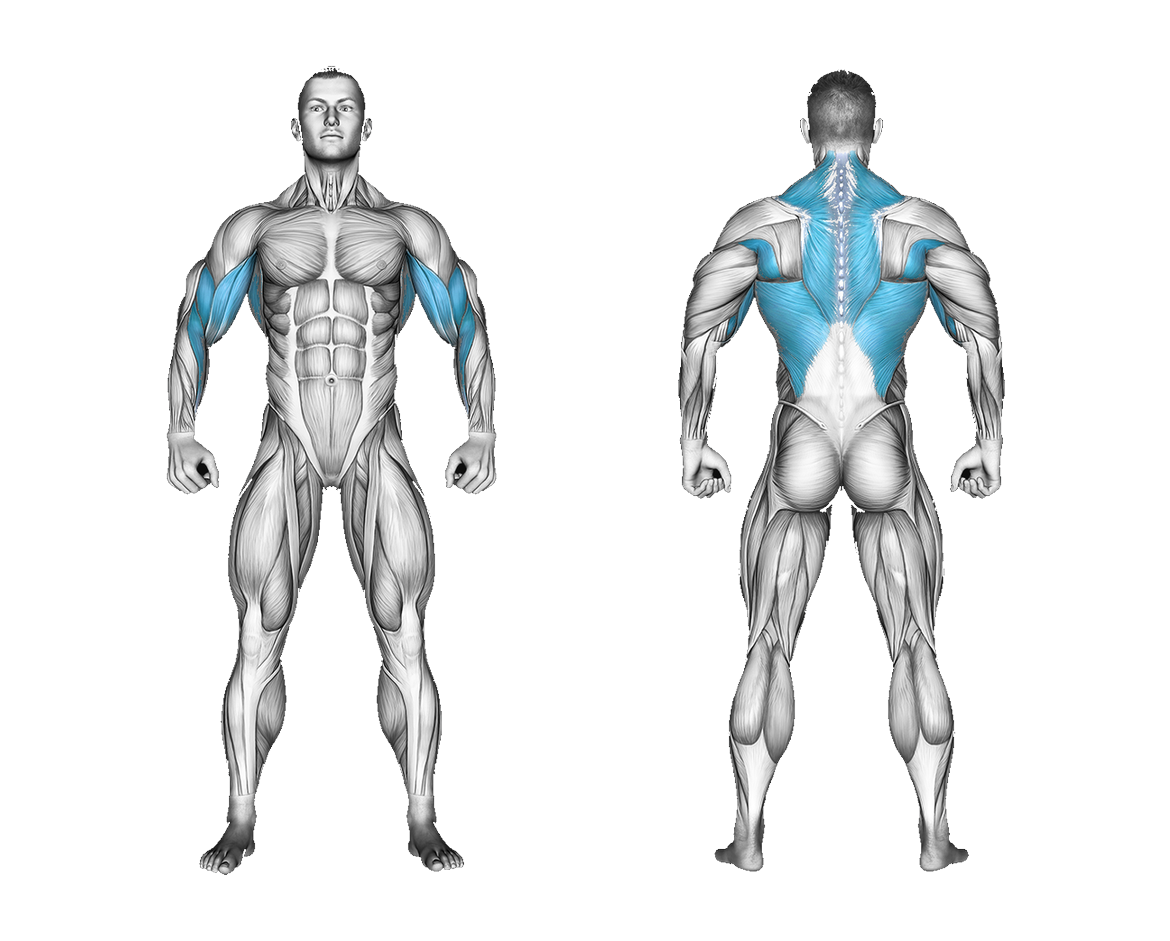
The band bent-over row is a compound pulling exercise using elastic resistance to strengthen the lats, rhomboids, rear delts, and biceps. It suits lifters of all fitness levels and works well in the early or middle phase of an upper-body workout.
- Equipment
- Resistance bands
- Type
- Strength
- Animation
- Men and women
How to do it
- Stand on the middle of the band with your feet hip-width apart, holding a handle in each hand.
- Hinge at your hips, pushing them back until your torso is about 45 degrees to the floor, with a flat back, slightly bent knees, and arms hanging down.
- Brace your core and inhale.
- As you exhale, pull the handles up toward your waist, driving your elbows back close to your body and squeezing your shoulder blades together.
- Pause for a moment at the top.
- Inhale and slowly lower the handles back to the starting position, keeping your back flat.
Common mistakes
- Rounding the lower back places excessive shear stress on the lumbar spine.
- Flaring your elbows out wide shifts the workload off the lats and strains the shoulder joints.
- Jerking your torso upward to move the band reduces muscular tension and increases the risk of lower back strain.
Tips
- Widen your foot stance on the band to increase the baseline resistance without swapping equipment.
- Lead the pull with your elbows and pause briefly at the top to fully contract your upper back.
- Keep your gaze fixed on the floor about three feet ahead to maintain a neutral cervical spine.
Sets and reps
Perform 3 to 4 sets of 12 to 15 repetitions with 60 to 90 seconds of rest to build back hypertrophy and muscular endurance. Select a band tension where the final few reps feel genuinely challenging while your torso angle remains static.
Muscles worked
Your coach guides every set
Turn on the coach in Gloox: it asks how you feel, picks the weight from your history and cues technique and rest. Rate each set and the next one is tuned to you.

On a computer? Point your phone's camera here to get the app.
Questions
Is the band bent-over row safe for the lower back?
Yes, as long as you maintain a firm hip hinge and a flat, braced back throughout the movement. If you experience back pain, stop immediately and consult a healthcare professional.
How does a band row compare to a barbell bent-over row?
A band creates progressive resistance that peaks at the top of the contraction, reducing joint strain in the stretched position compared to free weights. This makes it gentler on the connective tissue while still stimulating muscle growth.
Similar exercises
Resistance Band Bent over Row (Version 2)Resistance bands
Resistance Band One Arm Bent over RowResistance bands
Band Knelling Lat PulldownResistance bands
Band Straight Back Seated RowResistance bands
Resistance Band Seated RowResistance bands
Band Seated RowResistance bands
Resistance Band Standing RowResistance bands
Band Close Grip RowResistance bands