
Legs · Resistance bands
Resistance Band Kneeling Sissy Squat
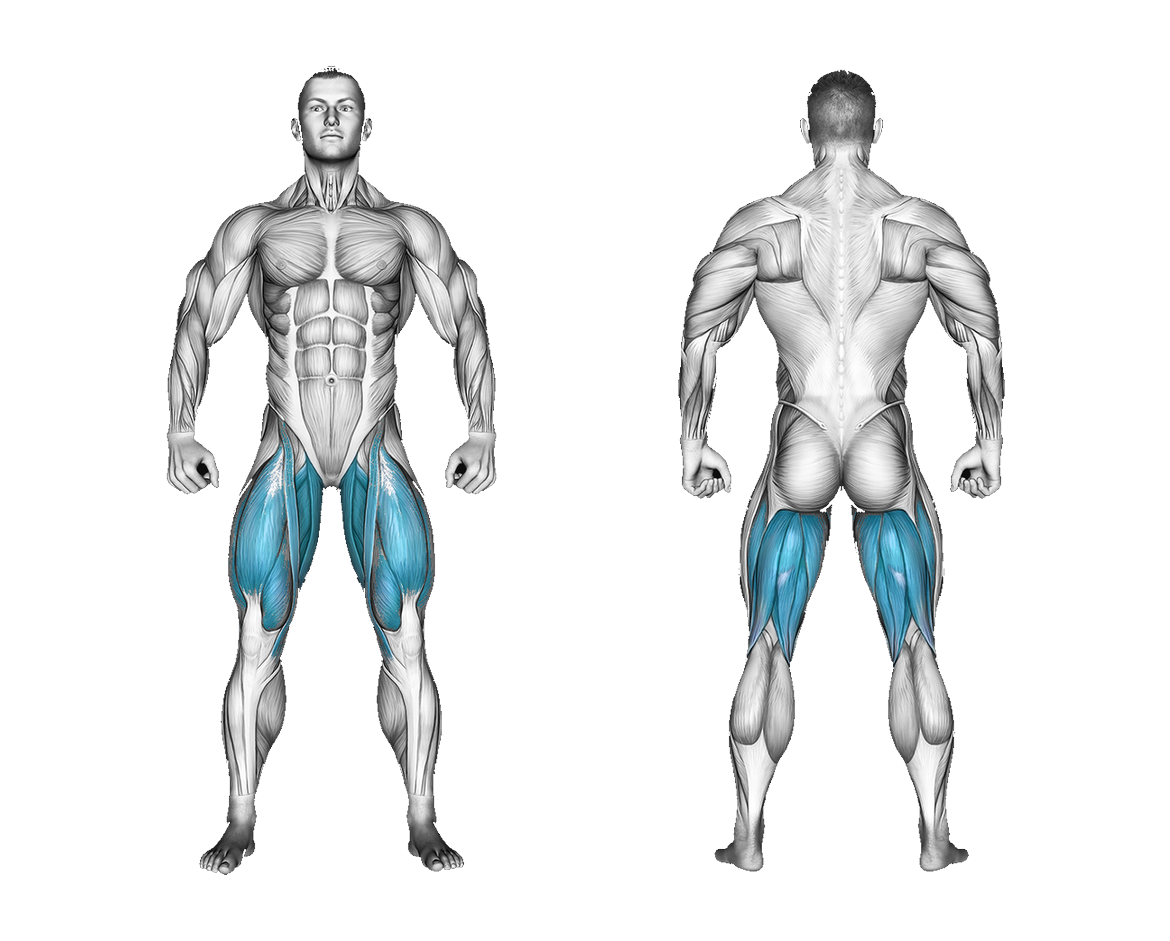
The resistance band kneeling sissy squat is an isolation exercise designed to heavily recruit the quadriceps, placing significant tension on the rectus femoris in a lengthened state. It works exceptionally well as a finishing movement at the end of a leg workout or as a regressed alternative to free-standing sissy squats.
- Muscles
- Legs
- Equipment
- Resistance bands
- Type
- Strength
- Animation
- Men
How to do it
- Loop the resistance band around a sturdy low anchor in front of you, kneel on a mat facing it and hold the band at your chest with both hands.
- Position your knees hip-width apart with your body upright, forming a straight line from your knees to your head.
- Inhale and lean your torso back as far as comfortable, keeping your hips extended and the line from knees to shoulders straight.
- Feel the tension in your thighs as the band supports part of your weight.
- As you exhale, contract your quads and pull yourself back up to the upright kneeling position.
Common mistakes
- Hinging at the hips as you lean back takes the stretch off the quadriceps and dramatically reduces muscular engagement.
- Arching the lower back compromises spinal stability and shifts tension away from the anterior thigh to the lumbar spine.
- Pulling yourself upright with your arms rather than driving through knee extension turns the exercise into an upper-body pull.
Tips
- Engage your glutes and brace your core firmly before each rep to hold a straight line from your knees to your shoulders throughout the movement.
- Place a folded exercise mat or foam pad under your knees to prevent uncomfortable pressure against the floor.
- Lower yourself backward on a controlled two- to three-second count to maximize eccentric tension on the quads.
Sets and reps
Perform 3 to 4 sets of 10 to 15 slow, controlled repetitions with 60 to 90 seconds of rest to optimize quadriceps hypertrophy and tendon resilience.
Muscles worked
Your coach guides every set
Turn on the coach in Gloox: it asks how you feel, picks the weight from your history and cues technique and rest. Rate each set and the next one is tuned to you.

On a computer? Point your phone's camera here to get the app.
Questions
Is this exercise safe if you have prior knee issues?
The resistance band provides assistance at the deepest angle of knee flexion to protect the joint, but if sharp or localized pain occurs, stop immediately and consult a physical therapist.
What is the main benefit of using a band compared to bodyweight alone?
The band counterbalances your torso as you lean back, making it easier to control the range of motion and maintain proper hip extension without overloading the knees.
Similar exercises
Band Hip AdductionResistance bands
Resistance Band Standing Single Leg Knee ExtensionResistance bands
Resistance Band Sitting Knee Extension on a ChairResistance bands
Band Seated Leg ExtensionResistance bands
Band Lying Leg CurlResistance bands
Resistance Band Leg CurlResistance bands
Band Standing Leg CurlResistance bands
Resistance Band Lying Single Leg CurlResistance bands