
Shoulders · Cable machine
Cable Lying Reverse Fly
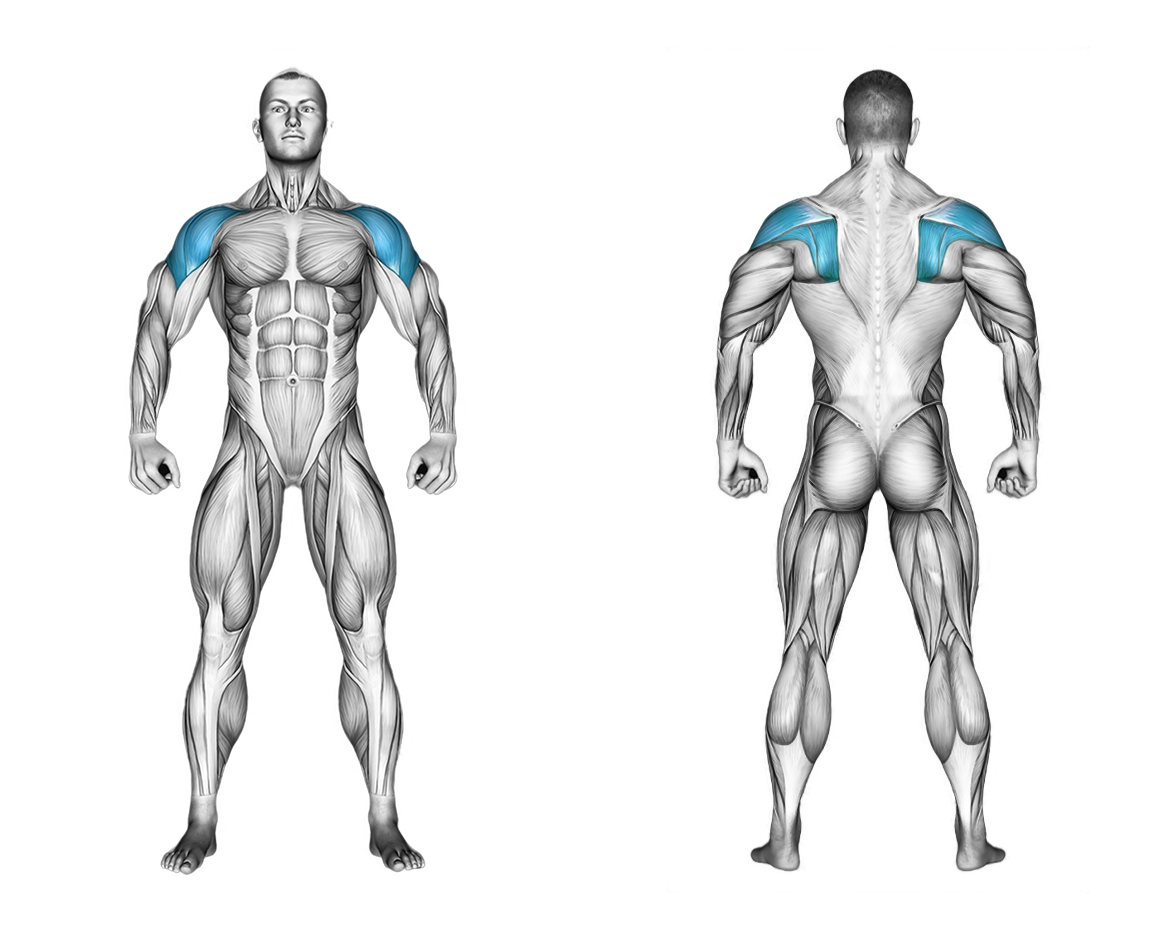
The cable lying reverse fly is an isolation exercise performed face-down on a bench to target the rear deltoids, rhomboids, and mid-trapezius muscles. It is effective for building balanced shoulders and improving posture, fitting best in the accessory portion of an upper-body or shoulder workout.
- Equipment
- Cable machine
- Type
- Strength
- Animation
- Men
How to do it
- Lie face-down on a flat bench positioned between two low cable pulleys.
- Grab the cable handles with opposite hands (right hand grabs left handle, left hand grabs right handle).
- With a slight bend in your elbows, pull the handles out to your sides in an arc motion.
- Squeeze your rear delts and upper back.
- Return to the starting position with control.
Common mistakes
- Bending the elbows too much turns the fly into a row, shifting tension away from the rear delts toward the lats.
- Lifting the chest off the bench using momentum reduces target muscle isolation and strains the lower back.
- Squeezing the shoulder blades together too early recruits the traps before the rear deltoids can fully engage.
Tips
- Position the bench centrally between the low pulleys so the cables pull symmetrically in line with your shoulders.
- Keep a constant, slight bend in your elbows throughout the movement rather than opening and closing the joint.
- Pause for a second at the peak of the movement to emphasize the contraction before controlling the negative phase.
Sets and reps
Perform 3 to 4 sets of 12 to 15 repetitions with 60 to 90 seconds of rest between sets to prioritize hypertrophy and maintain strict form.
Muscles worked
Your coach guides every set
Turn on the coach in Gloox: it asks how you feel, picks the weight from your history and cues technique and rest. Rate each set and the next one is tuned to you.

On a computer? Point your phone's camera here to get the app.
Questions
How does this compare to dumbbell reverse flies?
Cables provide constant resistance through the entire range of motion, whereas dumbbells lose tension at the bottom of the movement.
Is this variation safe if you have lower back discomfort?
Lying prone fully supports your torso, removing axial spinal load and making it much friendlier on the lower back than bent-over variations.
Similar exercises
Cable Bent over Contralateral Rear Delt RowCable machine
Cable 45-degrees Reverse-FlyCable machine
Cable Standing Face Pull (with-rope)Cable machine
Cable Half Kneeling Face PullCable machine
Cable Standing Face PullCable machine
Cable Upright RowCable machine
Cable Cross Over Reverse FlyCable machine
Cable One Arm Lateral RaiseCable machine