
Forearms · Barbell
Barbell Standing Reverse Wrist Curl
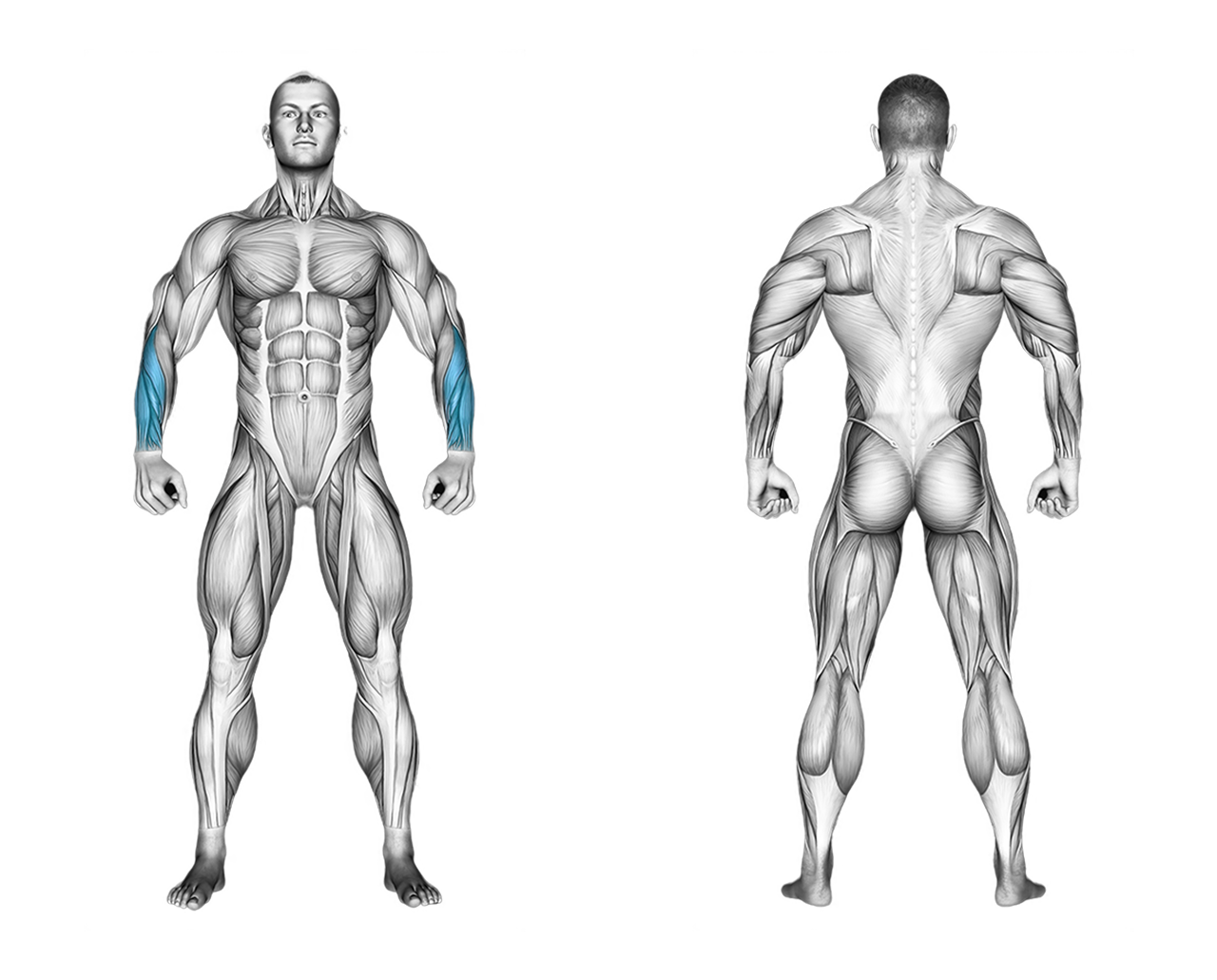
The barbell standing reverse wrist curl is an isolation movement targeting the wrist extensor muscles of the forearms. It is useful for improving grip stability and forearm thickness, fitting best at the very end of an arm or pulling workout.
How to do it
- Stand upright holding a barbell with an overhand grip, arms at your sides.
- Keep your forearms against your body and elbows stationary.
- Start with your wrists in a neutral position.
- Lift the barbell by extending your wrists upward as far as possible.
- Slowly lower the weight back to the starting position.
Common mistakes
- Bending at the elbows during the lift shifts tension away from the forearms and onto the biceps.
- Using too much weight reduces the active range of motion and places excessive stress on the wrist joints.
- Dropping the barbell quickly on the way down removes the eccentric tension and increases injury risk to connective tissue.
Tips
- Keep the elbows pinned against the sides of the torso to ensure only the wrists move.
- Hold the peak contraction at the top for one second to maximize extensor fiber recruitment.
- Switch to an EZ-curl bar if a straight barbell forces the wrists into an uncomfortable angle.
Sets and reps
Perform 3–4 sets of 12–20 repetitions with a moderate weight and strict form. Rest 60–90 seconds between sets to allow the smaller forearm extensors to recover adequately.
Muscles worked
Your coach guides every set
Turn on the coach in Gloox: it asks how you feel, picks the weight from your history and cues technique and rest. Rate each set and the next one is tuned to you.

On a computer? Point your phone's camera here to get the app.
Questions
What muscles does the standing reverse wrist curl target?
It targets the wrist extensors located on the top of the forearm, including the extensor carpi radialis and ulnaris. The brachioradialis and finger extensors also act as synergists.
Can dumbbells be used instead of a barbell?
Yes, dumbbells allow each wrist to move along its own natural path and can reduce joint strain. They are an effective direct substitute if a straight bar causes discomfort.
Similar exercises
Barbell Wrist Reverse CurlBarbell
Barbell Wrist Curl SeatedBarbell
Barbell Standing Wrist CurlBarbell
Cable Standing Wrist RollCable machine
Dumbbell Seated Neutral Wrist CurlDumbbells
Dumbbell Reverse Wrist CurlDumbbells
Dumbbell Standing Reverse Wrist CurlDumbbells
Dumbbell Reverse Wrist Curl Over BenchDumbbells