
Abs · Resistance bands
Resistance Band Plank Jack
The resistance band plank jack is a dynamic core exercise that challenges abdominal stability while targeting the glutes and hip abductors against elastic resistance. It works well as a high-intensity interval movement, a warm-up drill, or a conditioning finisher at the end of a workout.
- Muscles
- Abs
- Equipment
- Resistance bands
- Type
- Strength
- Animation
- Women
How to do it
- Loop the band around your ankles and get into a plank position on your forearms or hands, with your body in a straight line from head to heels.
- Brace your core and keep your hips level.
- As you exhale, jump both feet out to the sides, stretching the band.
- Inhale and jump your feet back together with control.
- Keep your hips from sagging or rising, and maintain a steady rhythm.
Common mistakes
- Bouncing the hips up and down during jumps shifts tension away from the core and strains the lower back.
- Allowing the lumbar spine to sag compromises spinal alignment and deactivates the deep abdominals.
- Snapping the feet back together without resisting the band reduces time under tension for the hip abductors.
Tips
- Position the band slightly above the ankles to keep it from slipping during rapid movements.
- Step one foot out at a time instead of jumping if you need to reduce joint impact or preserve lower-back stability.
- Stack your shoulders directly over your elbows or wrists to keep the upper body securely anchored.
Sets and reps
Perform 3 to 4 sets of 20 to 45 seconds, or 15 to 25 repetitions, resting 30 to 60 seconds between rounds to build core endurance and hip stability.
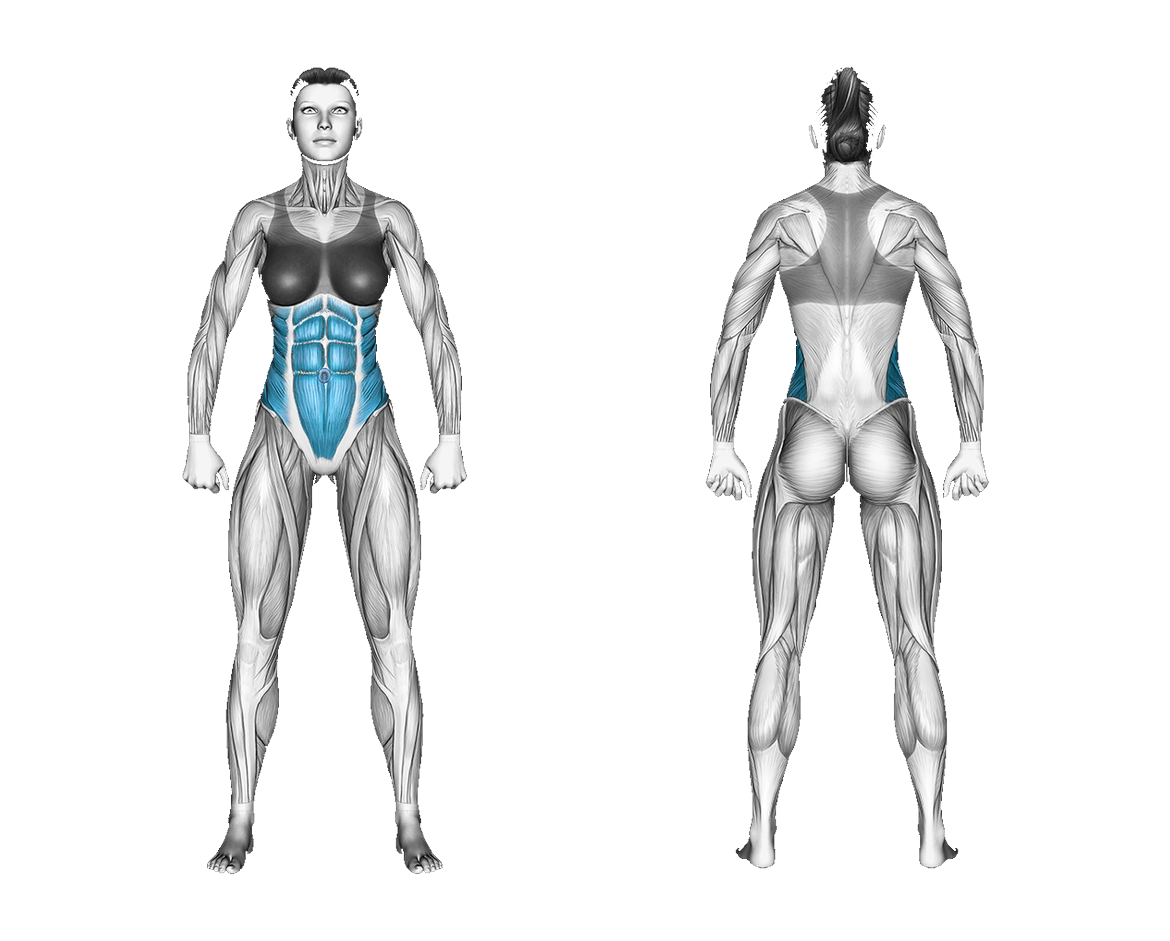
Muscles worked
Your coach guides every set
Turn on the coach in Gloox: it asks how you feel, picks the weight from your history and cues technique and rest. Rate each set and the next one is tuned to you.

On a computer? Point your phone's camera here to get the app.
Questions
What muscles does the resistance band plank jack work?
The rectus abdominis, transversus abdominis, and obliques work isometrically to stabilize the torso, while the gluteus medius and outer hips work dynamically against the band.
What should you do if this exercise causes lower back discomfort?
Switch to stationary plank toe taps to eliminate dynamic impact; if discomfort persists, stop the exercise and consult a specialist.
Similar exercises
Resistance Band Air BikeResistance bands
Band Half Kneeling ChopResistance bands
Resistance Band Standing Wood ChopperResistance bands
Band Side BendResistance bands
Band Overhead Side BendResistance bands
Resistance Band Reverse CrunchResistance bands
Band Standing Torso RotationResistance bands
Resistance Band Lying Leg RaiseResistance bands