
Legs · Resistance bands
Band Hip Flexion
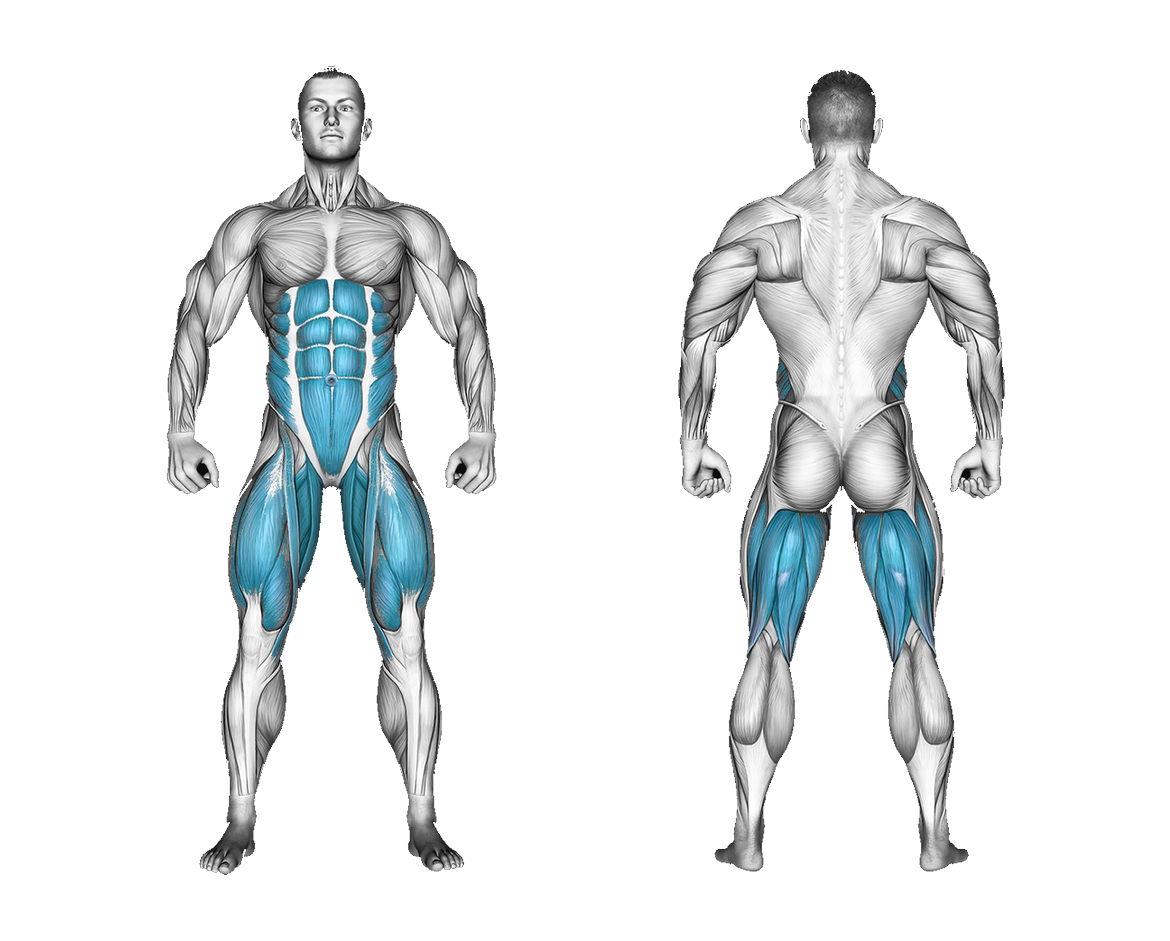
The band hip flexion is an isolation movement designed to strengthen the hip flexors—primarily the psoas and rectus femoris—along with the deep core. It is especially useful for runners and lifters looking to improve stride power and pelvic stability, fitting well into an active warm-up or at the end of a lower-body workout.
- Equipment
- Resistance bands
- Type
- Strength
- Animation
- Men
How to do it
- Attach the band to a low anchor behind you and slip your foot through one handle so it sits securely around your ankle.
- Step forward to create tension and stand tall, holding a wall or chair for balance if needed.
- Inhale, then as you exhale, drive your knee forward and up until your thigh is parallel to the floor.
- Keep your torso upright and your core braced throughout.
- Inhale and slowly return your leg to the starting position.
- Complete all repetitions, then switch legs.
Common mistakes
- Leaning the torso backward to hoist the knee up transfers tension into the lumbar spine instead of the hip flexors.
- Allowing the band to snap the leg back uncontrolled removes the beneficial eccentric training effect.
- Stopping the knee drive short of hip level prevents the target muscles from reaching a full, peaked contraction.
- Twisting the hips to the side instead of keeping the pelvis squared compromises balance and joint alignment.
Tips
- Lightly hold onto a sturdy wall or post for balance to isolate the working hip completely.
- Brace your core continuously throughout the movement to prevent your lower back from arching.
- Pause for one second at the top of the lift to maximize muscle activation before slowly lowering.
Sets and reps
Perform 3 to 4 sets of 12 to 20 controlled repetitions per leg to build muscular endurance and hip strength. Rest 45 to 60 seconds between sets.
Muscles worked
Your coach guides every set
Turn on the coach in Gloox: it asks how you feel, picks the weight from your history and cues technique and rest. Rate each set and the next one is tuned to you.

On a computer? Point your phone's camera here to get the app.
Questions
Is band hip flexion safe for the lower back?
Yes, provided you maintain an upright posture and keep your core braced to avoid hyperextending your lumbar spine. If you experience persistent back pain, stop the exercise and consult a specialist.
What can replace this exercise if resistance bands are not available?
Suitable alternatives include low-cable hip flexions using an ankle strap, hanging knee raises, or lying straight-leg raises with ankle weights.
Similar exercises
Resistance Band Psoas WalkResistance bands
Resistance Band Side Walk SquatResistance bands
Resistance Band Side LungeResistance bands
Resistance Band Lateral Step and SquatResistance bands
Resistance Band Bulgarian SquatResistance bands
Band Seated Hip Internal RotationResistance bands
Resistance Band Lying Leg PressResistance bands
Band Good MorningResistance bands