
Shoulders · Resistance bands
Band Y-Raise
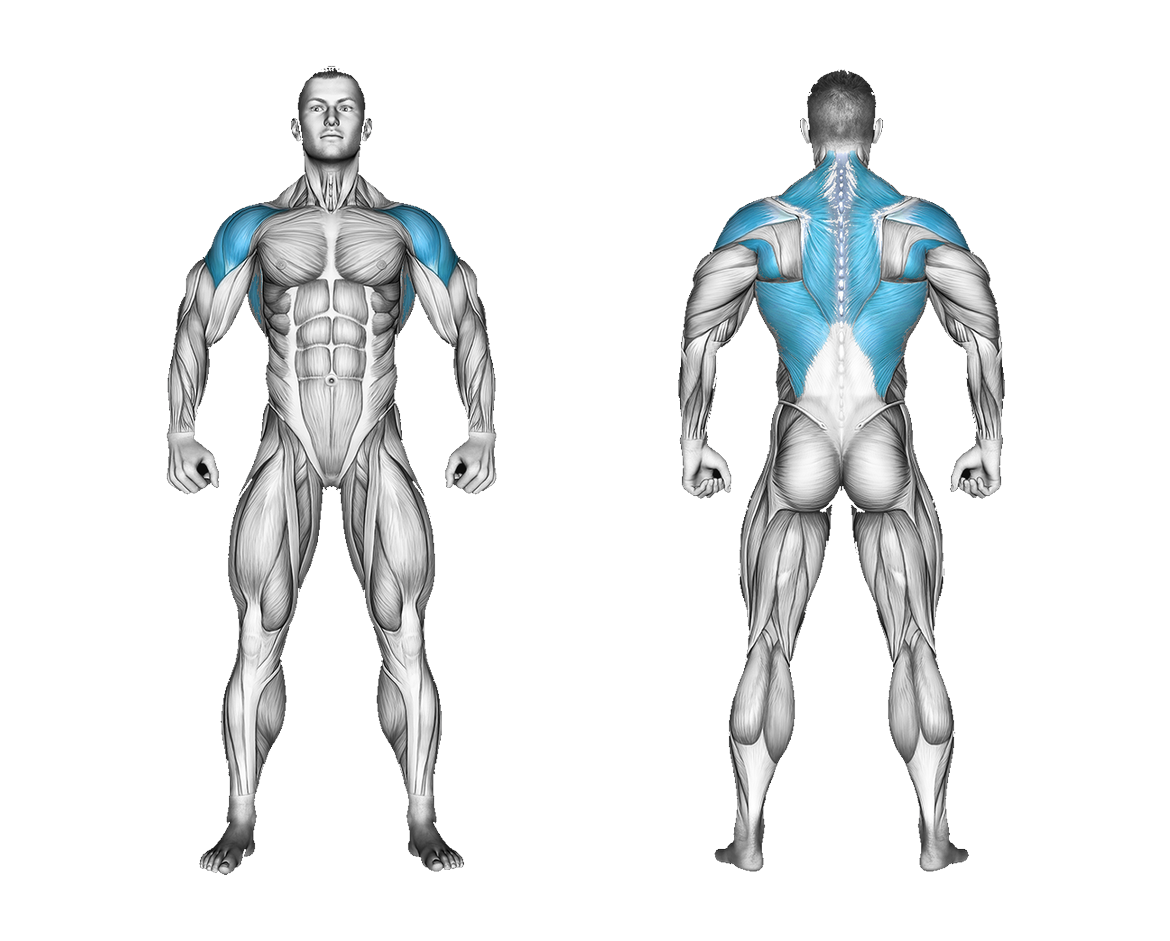
The band Y-raise is an isolation movement designed to strengthen the lower trapezius, deltoids, and scapular stabilizers. It is an effective exercise for improving posture and shoulder stability, making it ideal for a warm-up or an upper-body accessory block.
- Equipment
- Resistance bands
- Type
- Strength
- Animation
- Men
How to do it
- Stand on the middle of the band with your feet shoulder-width apart and take a handle in each hand in front of your thighs, thumbs pointing up.
- Keep your back straight, knees slightly bent, and core braced.
- Inhale. As you exhale, raise both arms up and out at an angle so your body forms a Y shape, stopping just above shoulder height.
- Keep your arms nearly straight and your shoulders down away from your ears.
- Inhale and slowly lower the handles back to the starting position.
Common mistakes
- Shrugging your shoulders toward your ears overactivates the upper traps and disengages the intended lower back muscles.
- Arching the lower back to raise the band steals tension from the shoulders and strains the spine.
- Bending the elbows significantly turns the exercise into a row and reduces leverage on the delts.
- Dropping the handles quickly on the way down eliminates time under tension during the eccentric phase.
Tips
- Pause for a full second at the top of each rep to maximize scapular muscle recruitment.
- Keep your thumbs pointed toward the ceiling throughout the movement to protect the rotator cuff.
- Adjust the resistance easily by widening or narrowing your foot stance on the band.
Sets and reps
Perform 3 to 4 sets of 12 to 20 reps with 45 to 60 seconds of rest to target muscular endurance and postural control.
Muscles worked
Your coach guides every set
Turn on the coach in Gloox: it asks how you feel, picks the weight from your history and cues technique and rest. Rate each set and the next one is tuned to you.

On a computer? Point your phone's camera here to get the app.
Questions
Can dumbbells replace the band for Y-raises?
Yes, but dumbbells work best when lying chest-down on an incline bench to provide resistance at the top of the range. Standing dumbbell Y-raises offer less tension in the overhead position compared to bands.
What should you do if you feel pinching or pain in your shoulder?
Limit your range of motion to pain-free levels or reduce band resistance. If sharp pain persists, stop the exercise and consult a specialist.
Similar exercises
Resistance Band Bent over Reverse FlyResistance bands
Resistance Band Sitting Bent over Reverse Fly on a ChairResistance bands
Band Reverse FlyResistance bands
Band Upright Row (Under Two feet)Resistance bands
Resistance Band Pull ApartResistance bands
Resistance Band Supinated Grip Pull ApartResistance bands
Band Bent over Rear Lateral RaiseResistance bands
Band Bent over Rear Lateral Raise (Version 2)Resistance bands