
Back · Resistance bands
Band Bent over Lat Pulldown
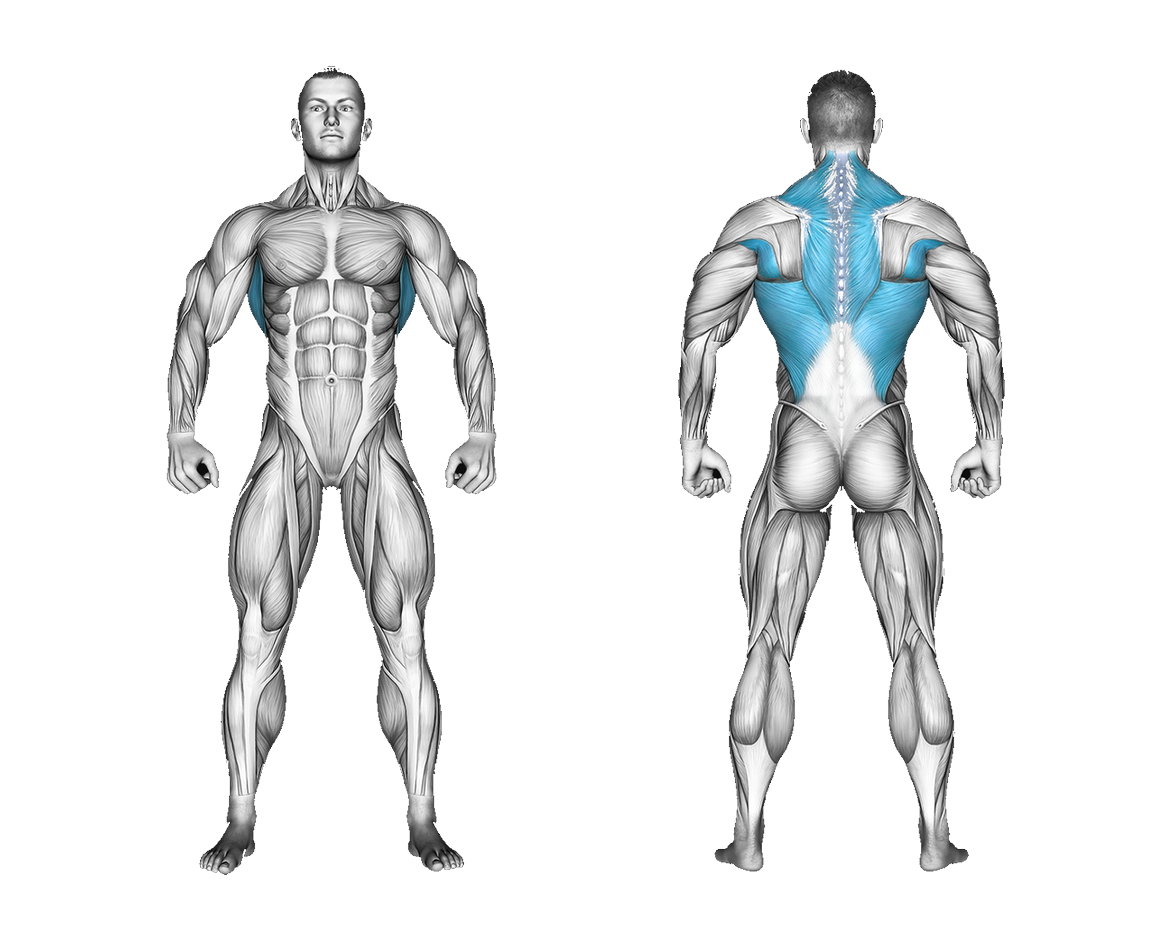
The band bent-over lat pulldown is an isolation exercise that targets the latissimus dorsi, teres major, and posterior core stabilizers using accommodating resistance. It serves well as a pre-exhaust primer before heavier pulling or as a low-fatigue finisher that spares the biceps.
- Muscles
- Back
- Equipment
- Resistance bands
- Type
- Strength
- Animation
- Men and women
How to do it
- Anchor the band at a high point, such as the top of a door, and take a handle in each hand.
- Step back until the band is taut, then hinge forward at the hips with your back straight and your arms extended up toward the anchor.
- Inhale and brace your core. As you exhale, pull the handles down toward your thighs with almost straight arms, driving your shoulder blades down and together.
- Squeeze your lats briefly at the bottom.
- Inhale and slowly let your arms return up toward the anchor.
Common mistakes
- Bending the elbows excessively turns the movement into a triceps extension or a row, shifting tension away from the lats.
- Rounding the lower back during the hinge creates shear stress on the lumbar spine and destabilizes the torso.
- Jerking the torso upward to initiate the pull uses momentum instead of controlled lat engagement.
- Allowing the band to snap the arms back rapidly eliminates eccentric tension and risks shoulder strain.
Tips
- Keep a subtle, locked bend in your elbows throughout the entire repetition.
- Initiate the movement by depressing your shoulder blades and pulling your hands down in an arc toward your hips.
- Step back far enough so the band remains under slight tension even when your arms are fully extended overhead.
Sets and reps
Perform 3–4 sets of 12–20 controlled repetitions with 45–60 seconds of rest between sets. Focus on a brief pause at peak contraction rather than using an excessively heavy resistance band.
Muscles worked
Your coach guides every set
Turn on the coach in Gloox: it asks how you feel, picks the weight from your history and cues technique and rest. Rate each set and the next one is tuned to you.

On a computer? Point your phone's camera here to get the app.
Questions
How does this differ from a standard cable straight-arm pulldown?
The mechanics are similar, but the resistance band provides ascending tension that peaks at the bottom of the movement, demanding maximum contraction where the lats are fully shortened.
What should you do if you feel tension in your lower back?
Reduce your forward hinge angle, brace your core tighter, or perform the exercise from a tall-kneeling stance to take stress off the lumbar spine.
Similar exercises
Band Kneeling One Arm PulldownResistance bands
Resistance Band Kneeling Cross Body Single Straight Arm PulldownResistance bands
Resistance Band Cross Body Single Straight Arm PulldownResistance bands
Resistance Band Kneeling Cross Body Lat PulldownResistance bands
Resistance Band Standing Lat PulldownResistance bands
Resistance Band Seated Wide RowResistance bands
Band ShrugResistance bands
Band Narrow Grip High RowResistance bands