
Back · Resistance bands
Resistance Band Floor Hyperextension
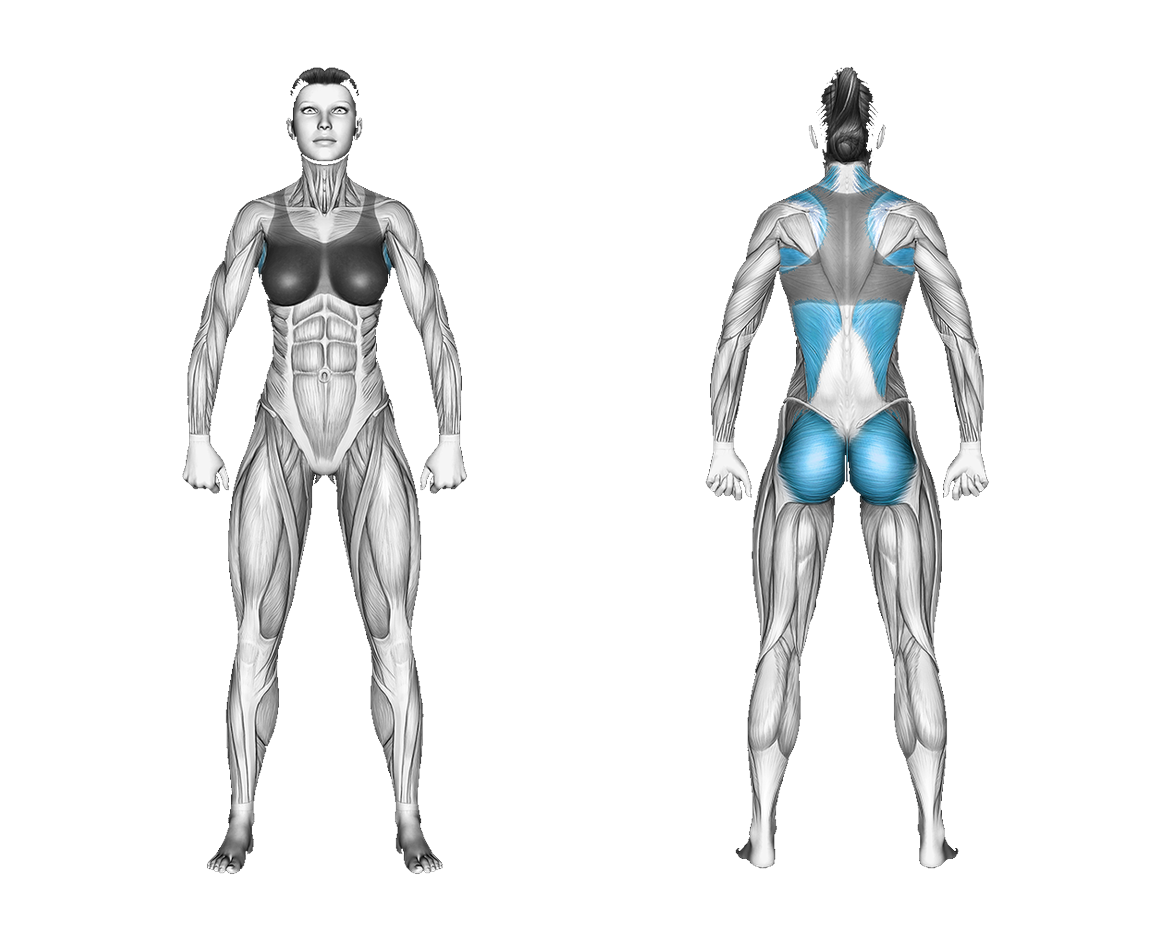
The resistance band floor hyperextension is an accessory movement that strengthens the spinal erectors and glutes without placing axial load on the spine. It is ideal for home workouts, postural routines, or as a posterior-chain warm-up before heavier lifts.
- Equipment
- Resistance bands
- Type
- Strength
- Animation
- Women
How to do it
- Lie face down on a mat and hook one end of the loop resistance band around both feet.
- Stretch the band along your back and place the other end across your upper back, holding it in place behind your shoulders with your hands.
- Keep your legs on the floor and your neck neutral. Inhale.
- As you exhale, lift your chest off the floor against the band's resistance, squeezing your lower back and glutes.
- Inhale and slowly lower your chest back down with control.
Common mistakes
- Craning your neck upward as you lift, which places unnecessary compressive stress on the cervical vertebrae.
- Using momentum to jerk the torso off the floor rather than relying on controlled muscular tension.
- Allowing your feet to lift off the floor, which causes the band to lose tension or slip away.
- Overextending the lower back beyond a comfortable range of motion, which jams the lumbar facet joints.
Tips
- Keep your eyes fixed on the floor directly beneath you to ensure a neutral spine from hips to head.
- Squeeze your glutes hard at the top of the movement and hold for one second before descending.
- Anchor the band securely under the arches of your feet and hold it firmly behind your shoulders throughout the set.
Sets and reps
Perform 3 to 4 sets of 12 to 20 controlled repetitions to build lower-back endurance and posture stability. Rest 45 to 60 seconds between sets.
Muscles worked
Your coach guides every set
Turn on the coach in Gloox: it asks how you feel, picks the weight from your history and cues technique and rest. Rate each set and the next one is tuned to you.

On a computer? Point your phone's camera here to get the app.
Questions
What should I do if I feel pain in my lower back during this exercise?
Stop the exercise immediately and consult a medical specialist if sharp pain occurs. If you only experience mild strain, try reducing the height of the lift or switching to a lighter resistance band.
Can this exercise replace the Roman chair hyperextension?
It serves as a viable floor-based alternative with a smaller range of motion, making it a great travel or home substitute. The resistance band provides progressive tension at the top where the glutes and erectors contract hardest.
Similar exercises
Band Narrow Grip High RowResistance bands
Resistance Band Lying Hyperextension AbductionResistance bands
Resistance Band Standing Archer Alternate Arm RowResistance bands
Resistance Band Shoulder AdductionResistance bands
Resistance Band Bent over Row (Version 2)Resistance bands
Band Bent over RowResistance bands
Resistance Band Renegade RowResistance bands
Resistance Band One Arm Bent over RowResistance bands