
Chest · Resistance bands
Band Chest Fly
The band chest fly is an isolation movement that targets the pectoral muscles with constant tension throughout the arc. It suits lifters of all experience levels and works best toward the end of a chest workout or as a main developer in home sessions.
- Muscles
- Chest
- Equipment
- Resistance bands
- Type
- Strength
- Animation
- Men
How to do it
- Attach the band to an anchor at chest height behind you and take a handle in each hand.
- Step forward into a staggered stance until the band is taut, arms out to your sides at shoulder height, elbows slightly bent.
- Inhale, then as you exhale, bring your arms together in a wide arc until your hands meet in front of your chest.
- Keep a slight bend in your elbows and squeeze your chest at the end point.
- Inhale and slowly open your arms back to the starting position.
Common mistakes
- Fully locking out your elbows shifts the mechanical load from your chest to your elbow joints and biceps tendons.
- Allowing your shoulders to roll forward at the end of the fly takes tension off the pectorals and strains the anterior deltoids.
- Letting the band snap your arms back during the negative phase eliminates eccentric muscle engagement and risks shoulder strain.
Tips
- Maintain a slight, fixed bend in your elbows so the movement stays focused solely on the shoulder joints.
- Step into a staggered stance and brace your core to prevent your torso from swaying as resistance peaks.
- Hold the peak contraction for a full second when your hands meet to maximize recruitment of the inner pectorals.
Sets and reps
Perform 3 to 4 sets of 12 to 15 controlled reps, resting 60 to 75 seconds between sets for optimal muscle hypertrophy and pump.
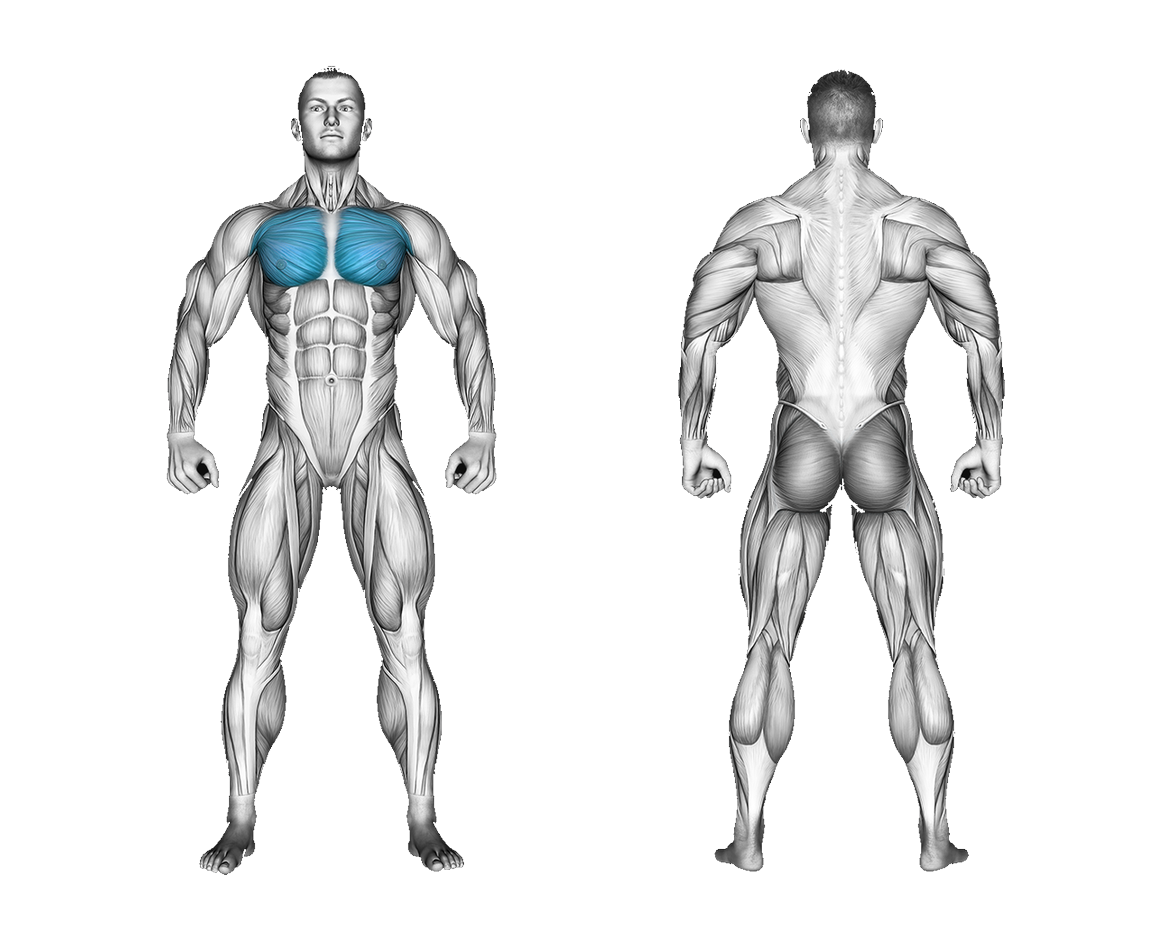
Muscles worked
Your coach guides every set
Turn on the coach in Gloox: it asks how you feel, picks the weight from your history and cues technique and rest. Rate each set and the next one is tuned to you.

On a computer? Point your phone's camera here to get the app.
Questions
What part of the chest does the band fly target most?
It targets the sternal head of the pectoralis major with high peak tension, especially during the contraction at the centerline.
Can band chest flies replace dumbbell flyes?
Yes, bands actually offer a more continuous resistance curve than dumbbells, where tension tends to drop off at the top of the movement.
Similar exercises
Band Cross Body One Arm Chest PressResistance bands
Band Alternate Low Chest FlyResistance bands
Resistance Band Single Arm FlyResistance bands
Resistance Band Single Arm Low Chest FlyResistance bands
Band Middle FlyResistance bands
Band Incline Chest FlyResistance bands
Band High FlyResistance bands
Band Low Chest FlyResistance bands