
Abs · Resistance bands
Resistance Band Plank March
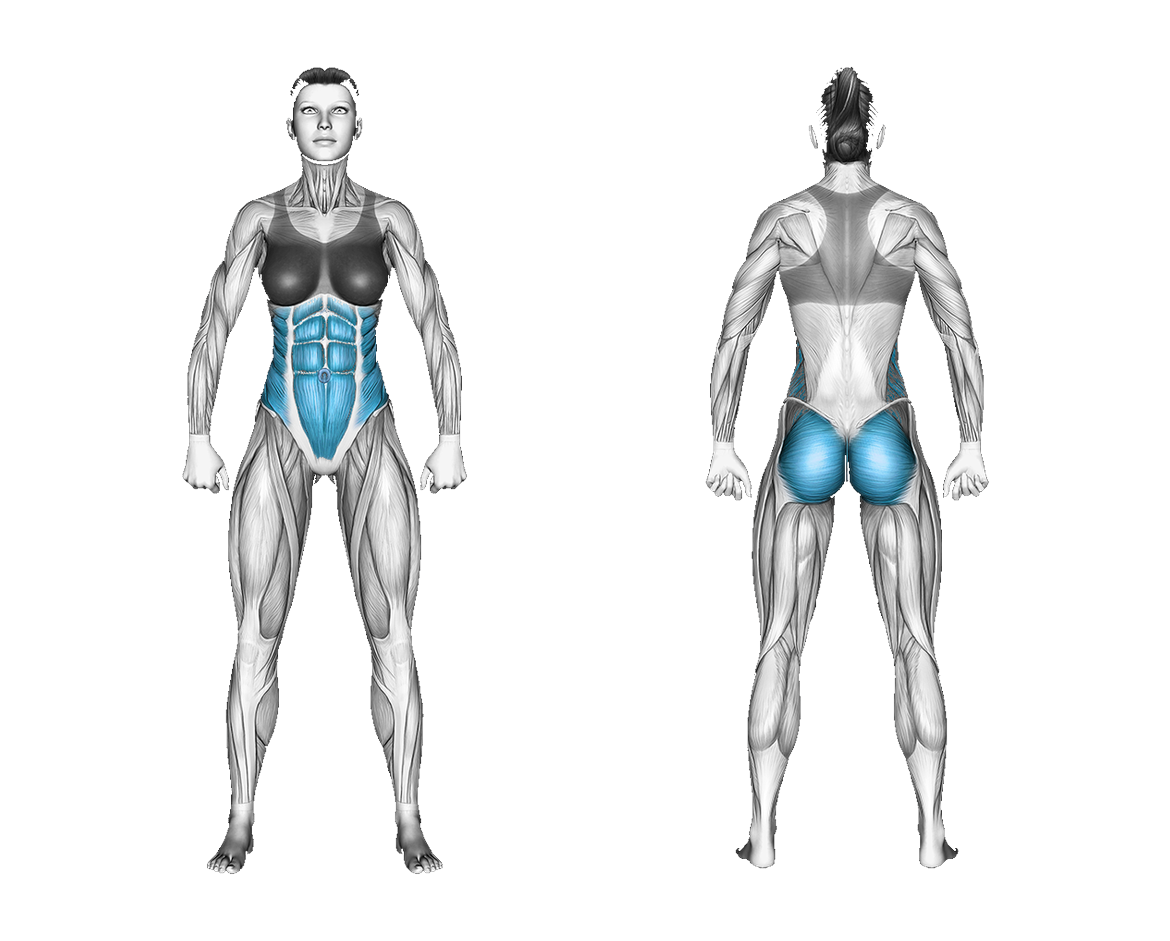
The resistance band plank march is a dynamic core and posterior-chain exercise combining an isometric high plank with alternating hip extensions. It challenges anti-rotation stability while strengthening the abdominal wall and glutes, making it an effective addition to movement preparation or a core-focused training block.
- Equipment
- Resistance bands
- Type
- Strength
- Animation
- Women
How to do it
- Loop the resistance band around both ankles.
- Get into a high plank with your hands under your shoulders and your body in a straight line from head to heels.
- Brace your core and keep your hips level.
- As you exhale, lift one leg up and slightly back against the band without bending the knee; inhale as you lower it.
- Exhale and repeat with the other leg, alternating in a controlled marching rhythm without rocking your hips.
Common mistakes
- Arching the lower back during the leg lift shifts tension into the lumbar spine instead of engaging the glutes and core.
- Rotating or rocking the hips side to side reduces the anti-rotational stabilization required of the abdominal muscles.
- Bending the knee of the lifting leg turns hip extension into a hamstring-dominant movement and limits glute recruitment.
- Placing the hands too far forward relative to the shoulders places unnecessary stress on the shoulder joints and weakens body alignment.
Tips
- Keep the toes of the lifting foot pointed straight down toward the floor to isolate the glute without flaring the hip open.
- Press firmly through the floor with both hands to maintain protracted shoulder blades and a solid upper-body foundation.
- Select a light-to-medium tension band that allows controlled leg raises without forcing the pelvis to tilt.
Sets and reps
Perform 3 to 4 sets of 16 to 24 total alternating reps (8 to 12 per leg) or work in timed intervals of 30 to 45 seconds. Rest for 45 to 60 seconds between sets.
Muscles worked
Your coach guides every set
Turn on the coach in Gloox: it asks how you feel, picks the weight from your history and cues technique and rest. Rate each set and the next one is tuned to you.

On a computer? Point your phone's camera here to get the app.
Questions
Is this exercise safe for the lower back?
The movement is safe when the abdominal wall stays braced to prevent hyperextension of the lumbar spine. If lower back pain occurs, discontinue the exercise immediately and consult a qualified specialist.
Where should the resistance band be placed?
Looping the band around the ankles provides optimal leverage and glute engagement. If hip rotation occurs or the band rolls up, move it slightly above the knees to reduce the lever arm.
Similar exercises
Resistance Band Air BikeResistance bands
Resistance Band Horizontal Pallof PressResistance bands
Band Horizontal Pallof PressResistance bands
Band Half Kneeling ChopResistance bands
Resistance Band Standing Wood ChopperResistance bands
Band Side BendResistance bands
Band Overhead Side BendResistance bands
Resistance Band Reverse CrunchResistance bands