
Glutes · Resistance bands
Resistance Band Leg Kickback
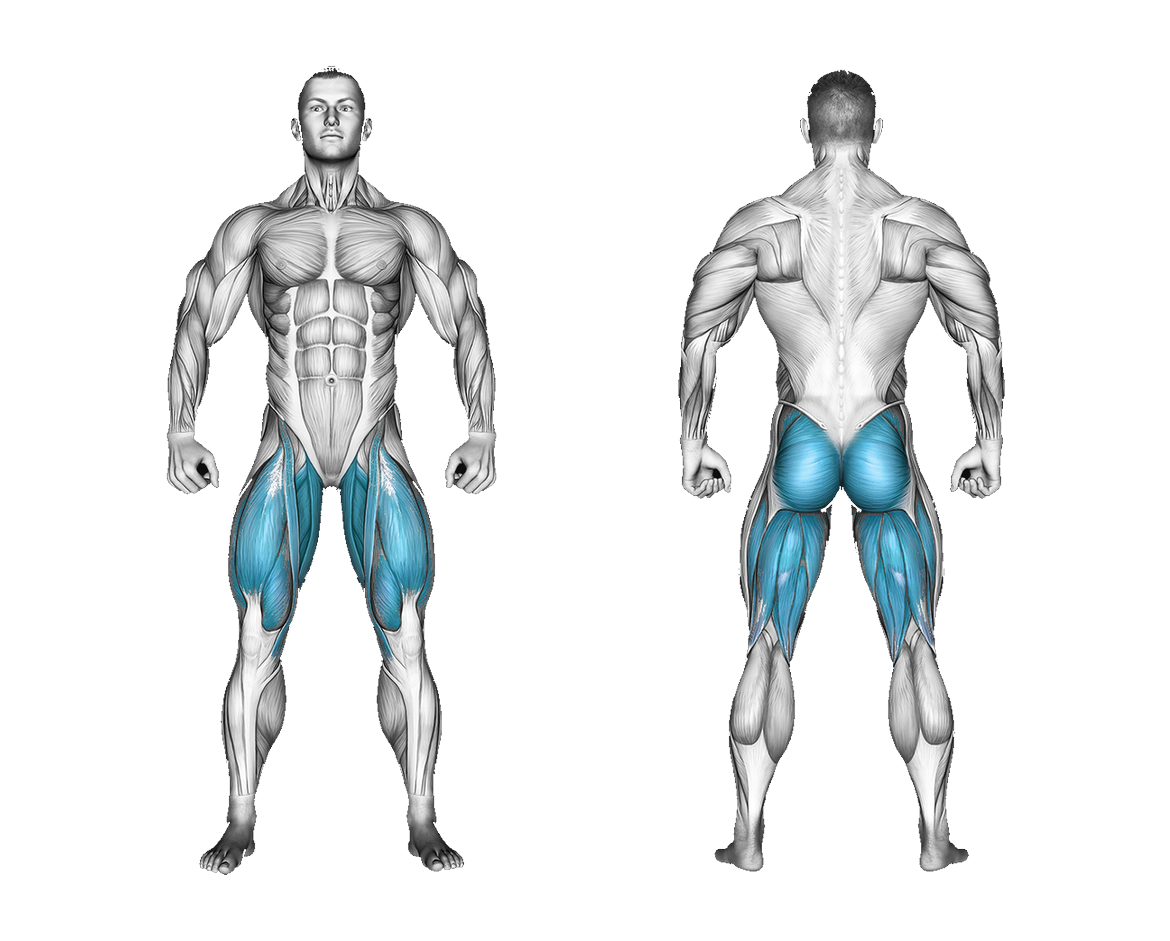
The resistance band leg kickback is an isolation movement designed to strengthen and shape the gluteus maximus and upper hamstrings. It is suitable for lifters of all fitness levels and works best as a glute activation drill before compound lifts or as a burnout exercise at the end of a workout.
- Equipment
- Resistance bands
- Type
- Strength
- Animation
- Men and women
How to do it
- Loop the band around both ankles and stand facing a wall or sturdy support, holding it lightly for balance.
- Shift your weight onto one leg and keep your torso upright with your core braced.
- Inhale. As you exhale, drive your other leg straight back and slightly up, squeezing your glute, without arching your lower back.
- Pause briefly at the top of the movement.
- Inhale and slowly bring the leg back to the starting position without letting the band go slack.
- Complete all reps, then switch legs.
Common mistakes
- Arching the lower back to lift the leg higher shifts tension away from the glutes and stresses the lumbar spine.
- Using swinging momentum rather than controlled muscle contraction reduces the constant resistance provided by the band.
- Opening the hips to the side takes the focus off the primary glute muscles and compromises pelvic stability.
- Allowing the band to go completely slack between reps eliminates mechanical tension prematurely.
Tips
- Keep a slight bend in your standing knee to maintain balance and protect the joint.
- Pause for a full second at peak extension to maximize glute contraction before slowly returning.
- Hinge slightly forward at the hips while bracing your core to enable a full range of hip extension without spinal hyperextension.
Sets and reps
Perform 3 to 4 sets of 15 to 20 controlled repetitions per leg, resting 45 to 60 seconds between sides.
Muscles worked
Your coach guides every set
Turn on the coach in Gloox: it asks how you feel, picks the weight from your history and cues technique and rest. Rate each set and the next one is tuned to you.

On a computer? Point your phone's camera here to get the app.
Questions
Is this exercise safe if I have lower back pain?
It is generally safe when performed with an upright or braced neutral spine, but hyperextending can trigger discomfort. If sharp pain occurs, stop immediately and seek guidance from a qualified specialist.
Where should the resistance band be placed?
Placing the band around the ankles provides the greatest challenge due to longer leverage, while looping it just above the knees offers an easier regression.
Similar exercises
X-Band Side WalkResistance bands
Resistance Band Single Leg BridgeResistance bands
Resistance Band One Leg Kickback (Bent Position)Resistance bands
Band Kneeling Rear KickResistance bands
Band Hip LiftResistance bands
Resistance Band Pull ThroughResistance bands
Band Pull ThroughResistance bands
Band Bent over Hip ExtensionResistance bands