
Glutes · Machines
Lever Standing Hip Extension
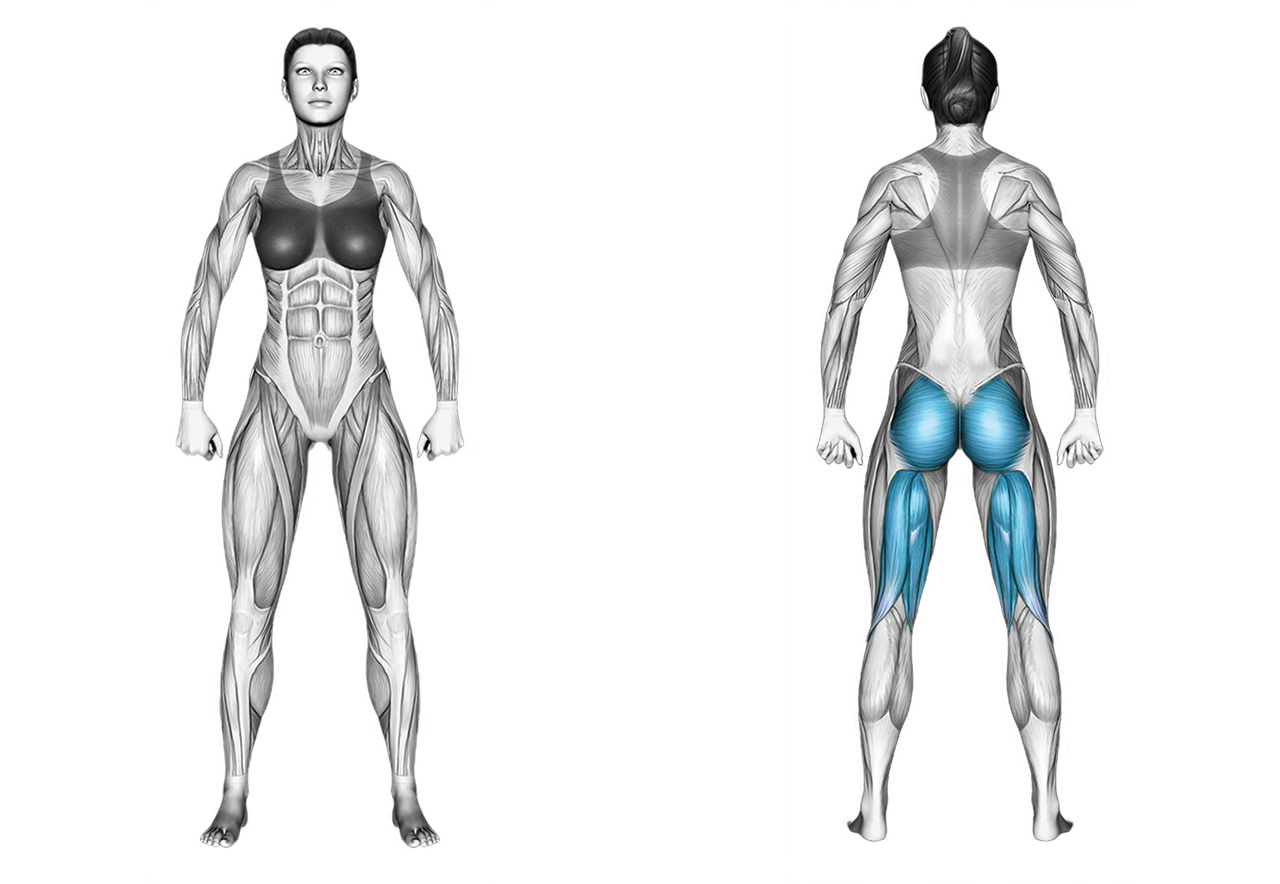
The lever standing hip extension is an isolation exercise designed to directly target and strengthen the gluteus maximus. It works well as an accessory movement at the end of a lower-body workout or as an activation drill prior to compound lifts.
How to do it
- Stand facing a cable machine with an ankle strap attached to the low pulley.
- Secure the strap around your ankle and hold onto the machine for support.
- Keep your standing leg slightly bent and your core engaged.
- Slowly extend your attached leg backward, focusing on squeezing your glutes.
- Pause at the end range of motion, then return to the starting position.
Common mistakes
- Arching the lower back during the extension shifts mechanical load away from the glutes onto the lumbar spine.
- Swinging the leg with momentum eliminates constant tension and reduces control during the lowering phase.
- Rotating the hips open changes the movement plane and engages the abductors instead of the gluteus maximus.
Tips
- Brace the core firmly to keep the torso and pelvis steady throughout the entire set.
- Pause for one second at peak contraction while actively squeezing the working glute.
- Maintain a slight bend in the supporting knee to stabilize the body and protect the joint.
Sets and reps
For hypertrophy and local muscular endurance, perform 3 to 4 sets of 12 to 15 reps per leg with 60 to 90 seconds of rest between sets.
Muscles worked
Your coach guides every set
Turn on the coach in Gloox: it asks how you feel, picks the weight from your history and cues technique and rest. Rate each set and the next one is tuned to you.

On a computer? Point your phone's camera here to get the app.
Questions
How does this exercise compare to a barbell hip thrust?
Barbell hip thrusts allow for heavier systemic loading across both legs, while the standing lever extension isolates each glute individually without spinal loading.
Why does lower back pain occur during this movement?
Pain usually indicates hyperextending the lumbar spine at peak range of motion; shorten the kickback distance, and if discomfort persists, stop the exercise and consult a specialist.
Similar exercises
Lever Hip ExtensionMachines
Lever Hip ThrustMachines
Resistance Band Lateral WalkResistance bands
Resistance Band Bent Leg Side Kick (kneeling)Resistance bands
Band Seated Hip External RotationResistance bands
Barbell Lunge TwistBarbell
Cable Donkey Diagonal KickbackCable machine
Cable Donkey KickbackCable machine