
How to track a client's nutrition as a personal trainer
Tracking a client's food shouldn't turn into reviewing every plate in a chat. Three things are enough: a macro target, a food diary the client keeps themselves, and a weekly check of weight against calories.
Calorie target
Start with the Mifflin–St Jeor formula and an activity factor: that's what the client burns on a normal day. Then adjust for the goal:
- Fat loss: 10–20% below maintenance. Go further and the client will break down and lose strength in the gym.
- Muscle gain: 5–10% above. If weight climbs faster than 0.5 kg (1 lb) a week, it's mostly fat.
- Maintenance and recomposition: calories at maintenance, with the focus on protein and strength training.
The calorie calculator does the math. The target is only a starting point; after 2–3 weeks the client's real weight trend corrects it.
Protein, fat and carbs
- Protein: 1.6–2.2 g per kg of body weight (0.7–1 g per lb), toward the top end in a cut. The protein calculator helps.
- Fat: about 25–30% of calories and at least 0.6–0.8 g per kg.
- Carbs: whatever is left, the fuel for training.
The food diary: setting expectations
- Ask for two weeks of honest logging without judgment: first you need to see how the client really eats.
- Don't demand weighing every gram: a plate photo or a voice note gives an estimate good enough for decisions.
- Weekends count; that's where the extra calories usually hide.
- Aim for 80% of days on target, not a perfect week.
What to check once a week
- Average weight this week vs last week; one weigh-in tells you nothing.
- Average calories and protein vs target.
- Weight flat for 2–3 weeks with an honest diary: take 100–150 kcal off the target. Dropping faster than 1% of body weight a week: add some back.
- How the client feels and lifts: if strength is falling, the deficit is too big.
What it looks like in Gloox
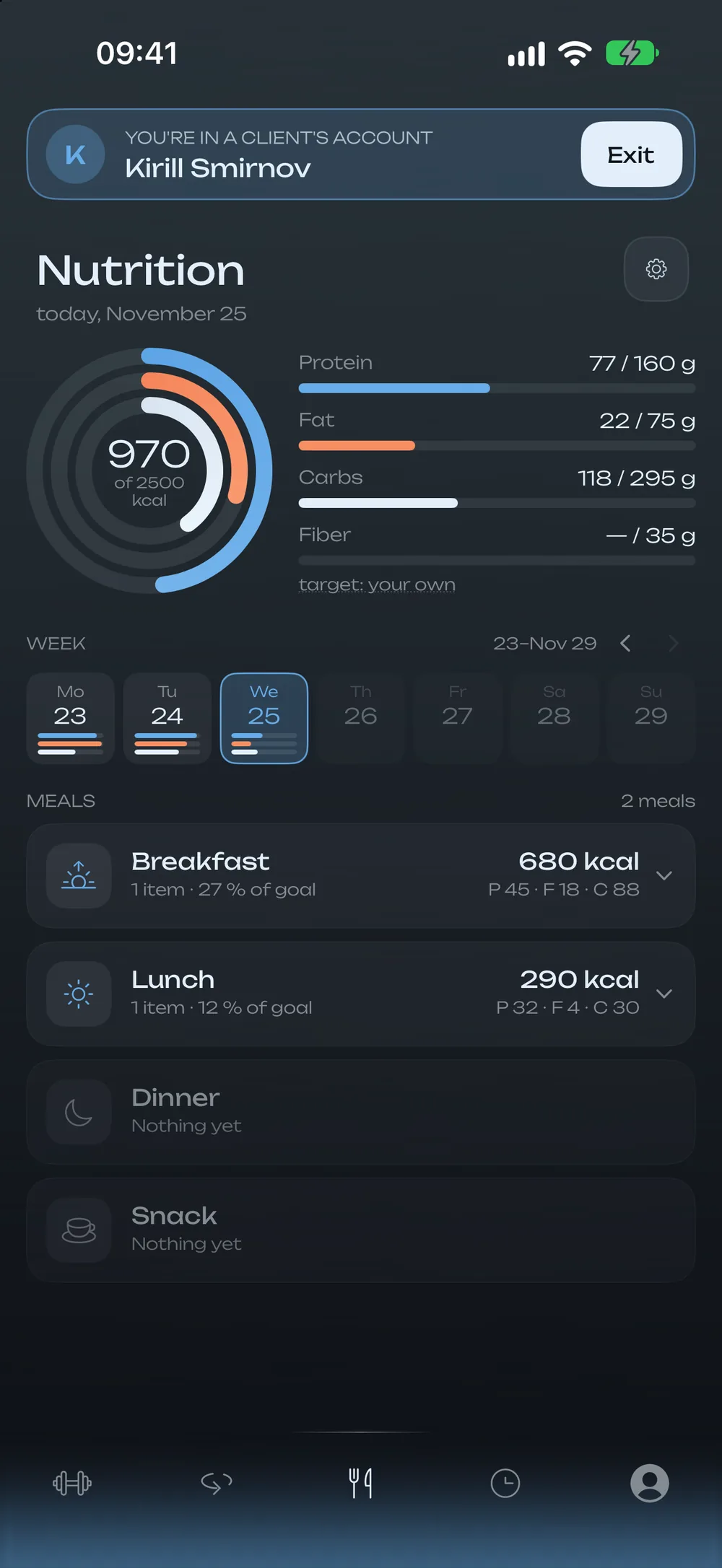
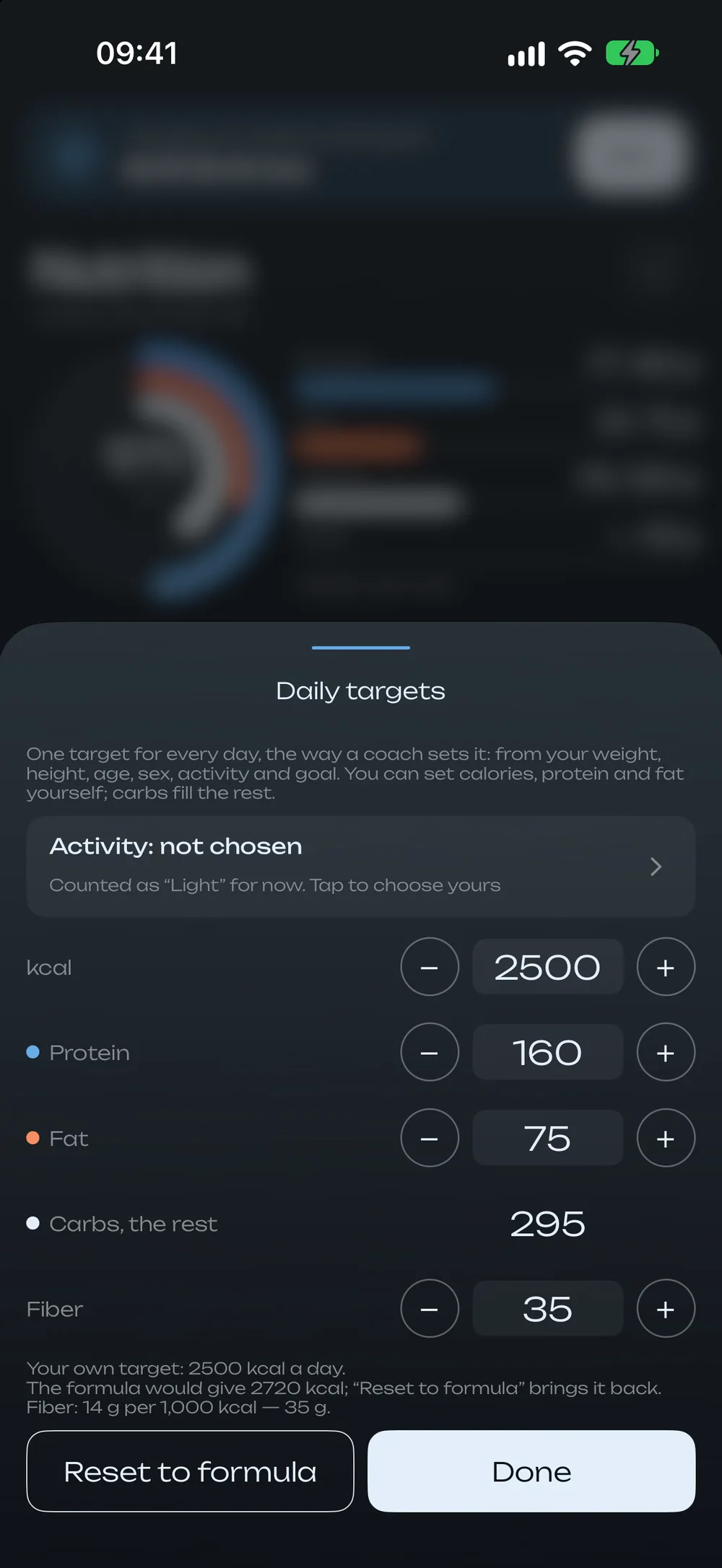
The client logs food in their own app: a plate photo, by voice, by barcode or by search. If they share their nutrition diary with you, you see it by day and meal, and today's food right in the client's profile. If they allow you to change their calorie and macro target, you set calories, protein and fat with − and +, carbs fill the rest, and the client sees the new target in their app.
More about Trainer Mode: Gloox for trainers.
Your clients' food in Gloox
Your client's food diary, macro targets and weight on your phone. Your clients train on your programs for free.

On a computer? Point your phone's camera here to get the app.
Questions
How much protein does a client need?
Usually 1.6–2.2 g per kilogram of body weight (0.7–1 g per lb). In a fat-loss phase, closer to 2 g per kg to keep muscle.
Does the client have to weigh their food?
Not necessarily. A plate photo or a voice note gives a rough estimate, and that's enough for weekly decisions. A kitchen scale helps when progress stalls while the diary looks perfect.
How often should the calorie target change?
No more than once every 2–3 weeks, and only based on the weekly average weight. Change it in steps of 100–150 kcal.
More guides
- An AI coach that guides every set
- Best AI personal trainer apps in 2026
- Gloox vs Fitbod
- Gloox vs Hevy
- Gloox vs Freeletics
- Best Fitbod alternatives in 2026
- Best apps for personal trainers in 2026: Gloox, Trainerize, TrueCoach and Everfit
- How to coach clients online: a simple system for personal trainers
- How to write a training program for a client
- How to move client programs from Excel and notes into an app
- Free workout log template for Excel and Google Sheets
- How to choose your working weight
- How many sets do you need to build muscle?
- A 3-day workout plan that works
- Beginner Gym Workout Program
- Workout Program for Muscle Gain
- Gym Workout Program for Fat Loss
- Gym Workout Program for Women
- How Many Days a Week Should You Train?